
MeTravel city quest
A quest through Hel: the bells of the sunken city
Hel: a free walking route “A quest through Hel: the bells of the sunken city” past the sights. Self-guided, any day, no booking. 14 points.
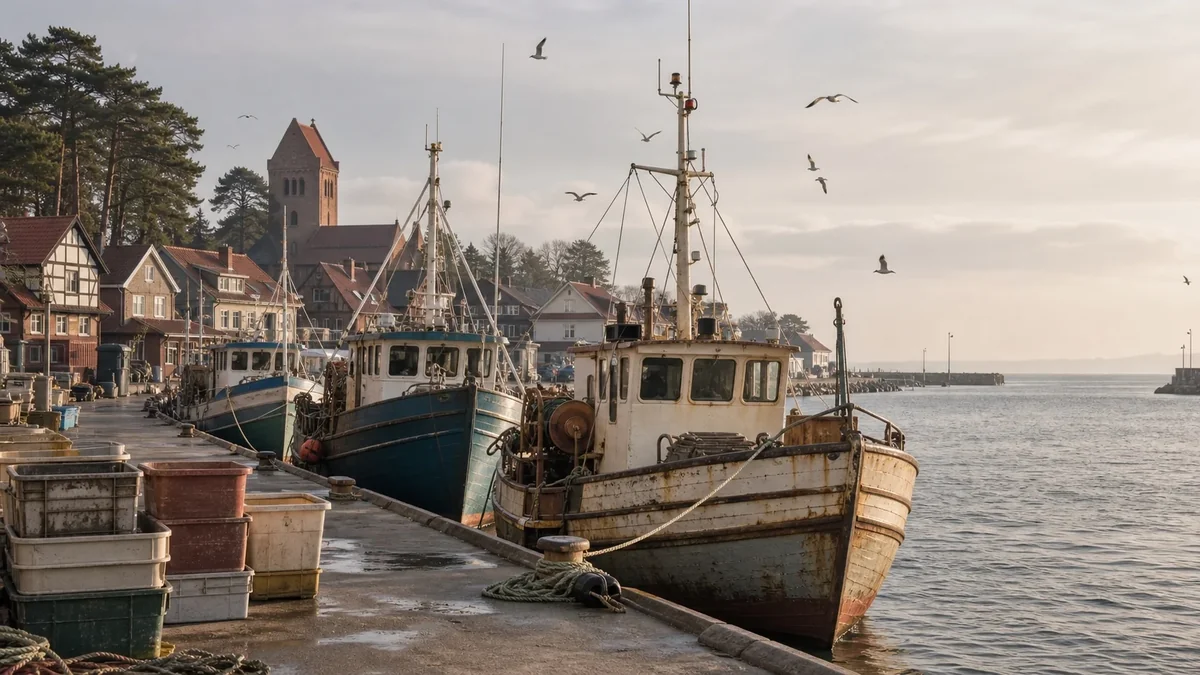
There were two Hels.
The first stood over there — a few hundred metres north-west of today's fishing port, where now there is only the water of the bay. It was rich past the point of decency: amber, trade, shipyards, nine inns for a small town, and a mechanical clock on the town hall — a rarity in the Pomerania of that time. Gdańsk looked at it sideways, with irritation.
And then Hel vanished.
The legend tells it like this. Wealth spoiled the town: the strong of Hel grew proud, stopped helping one another, and pressed harder and harder on those who were poorer — the craftsmen and the ordinary fishermen. And one night, on the eve of Zielone Świątki, Whitsun, while the rich were feasting, the Baltic rose. The storm lasted until morning, and the water took the streets one by one. The poor were in time: they gathered in the church, and from there they went up onto the dunes — and survived. The rich, drowsy from the feast, noticed nothing and went under the water with their houses. The church drowned too. But the bells, they say, stayed whole — and since then you can sometimes hear them from the bottom.
History argues with the legend only about the pace. Old Hel really did exist: a stronghold from the 9th century, town rights around 1260, one thousand two hundred inhabitants, its own book of town laws from 1430. It did not go in a single night — the sea ate at it for centuries, the fire of 1572 finished it off, and by the beginning of the 18th century only abandoned ruins were left on that spot. In 1935, when a naval port was being built nearby, fragments of the town walls were found several metres down. The dig was shut down: the port mattered more.
And the second Hel — the one you are standing in now — was built by the very people who went up onto the dunes. Fishermen. Kashubs: not “Poles with an accent”, but a separate Baltic people with their own language and a stubborn character. The whole route is about what the town of the poor made of the second chance it was given.
You will have to look with your eyes: Hel is a town of an incredible density of inscriptions. Plaques on houses, on stones and on crosses tell its history better than any guidebook, and everything the tasks will need can be read straight off them — not off the internet.
The logistics are simple. About 1.7 km from north to south, almost no doubling back: two to two and a half hours with all the stops. The start is at the railway station: if you came by train, you are already there; in season, leave the car in the paid car park by the port and walk up to the start. The first stop is optional: the old cemetery, three hundred metres to the north; if you skip it, you lose nothing in the tasks. Further along there will be three more optional stops: the villa of the first oceanographer, the seals, and the fried fish people come to Hel for on its own.
Let's go. The finish is by the water, facing the place where the first Hel lies.
- City: Hel
- Route: 14 points
- Time: about 2 h 20 min
- Start: Hel, from the railway station to the Fishermen's Pier (about 1.7 km)
- Format: self-guided, any day, no booking
What is on the route
The route points in order — what these places are and why they are interesting. Tasks and answers stay inside the quest.
✨ Prologue: the old cemetery (optional) — Town cemetery, ul. Dworcowa, Hel
The first stop is optional: three hundred metres north of the railway station. This is the most serious page of the town, and we honestly put it in a prologue — from here on the route will have a completely different mood.
The house of a fisherman who became the Kashubian Sienkiewicz — Augustyn Necel's house, ul. Generała Władysława Sikorskiego, Hel
Two hundred metres west from the railway station, and we are in the Fishermen's Colony. Remember what, according to the legend, the sea took the first Hel for: for contempt of the fishermen.
The park by the station: ten tonnes in the Guinness Book — Park by PKP Hel station, ul. Dworcowa / ul. Lipowa, Hel
We come back to the railway station — to the park at the northernmost railway terminus in Poland. The first Hel was proud of the mechanical clock on its town hall: an expensive machine the neighbours did not have — and the whole point was that the neighbours should not have it.
A Kashub from his grandfather's grandfather — Memorial stone of Jan Myślisz, ul. Stefana Żeromskiego, Hel
Two hundred metres east, to the little square by the church. Here lies a stone to a man who lived eighty years and, the whole way, answered one and the same question: who are you.
The church the fishermen begged for — Parish church, ul. Stefana Żeromskiego 1, Hel
Twenty steps — and you are at the place where the legend of the bells gets a continuation in real life. Remember: according to the tradition, a church stayed under the water, and its bells can sometimes be heard from the bottom.
✨ The villa by the port: the first oceanographer lived here (optional) — Villa with the memorial plaque to K. Demel, ul. Portowa, Hel
From here to the finish you can go two ways. The direct way is down Wiejska, to the laboratory.
✨ Fokarium: the ones they return to the sea (optional) — Fokarium of the Marine Station of the Institute of Oceanography, University of Gdańsk, ul. Morska 2, Hel
A hundred metres along the water — and you are at the best-known spot in Hel, which we, however, are not making compulsory either. The legend of the first Hel is about how the sea takes.
Opening hours: opens at 9:30, closing depends on the season (out of season until 16:00); feeding shows at 11:00 and 14:00, in July–August there is sometimes a third show · Ticket: 25 zł, reduced 20 zł (prices from 1 May 2026, check at the ticket office)
✨ A pause: the herring with a straight five (optional) — Food truck “U Marchewki w Helu”, ul. Morska, by the steps down to the boulevard, Hel
The middle of the route is time to eat, and there is exactly one thing to eat here. The first Hel grew rich on herring and went broke on it too.
Opening hours: usually Thu–Sun 11:00–16:00; out of season and in bad weather it may not open
The house where Polish science of the sea began — Memorial plaques of the Marine Fisheries Laboratory, ul. Wiejska 40, Hel
We return to Wiejska — the town's main street — and go south. An ordinary house, two memorial plaques, and behind them the best answer the second Hel gave the first.
The oak older than the whole town around it — Oak “Franciszek”, ul. Wiejska 46, by the former presbytery, Hel
A hundred metres further along Wiejska stands the only living witness on this route. His name is Franciszek, and by local tradition his age is counted from 1655.
The church that became a fisheries museum — Fisheries Museum, Bulwar Nadmorski 2, Hel
Here it is — the oldest house in the town, and the heart of our whole story. The Gothic church of Saints Peter and Paul was built in the 14th and 15th centuries, when the first Hel was still alive and rich.
Opening hours: Tue–Sun, roughly 10:00–16:00 (hours change with the season, Monday closed) · Ticket: roughly 23 zł, reduced 17 zł; the tower is paid separately — check at the ticket office
The fisherman apostle and the anchor hauled up in the nets — Shrine of Hel's patron and the old anchor, ul. Żeglarska / Bulwar Nadmorski, Hel
We go down onto the boulevard. Here, on a patch of twenty steps, three things stand at once, and together they add up to an answer to our whole legend.
The cross on the boulevard: two halves of one sentence — Fishermen's cross, ul. Żeglarska, by Bulwar Nadmorski, Hel
Twenty steps further south — the last land stop of the route, and here we come back to the sentence from the prologue. At the cemetery, if you went there, stood a stone “to those brothers whom the sea did not give back to us”.
Fishermen's Pier: the ones who come back — Fishermen's Pier, port of Hel, Bulwar Nadmorski, Hel
The finish. Two hundred metres along the water — and you are on a working quay: not a promenade, but the one where they unload boxes and mend nets.
Where to go next
This route is part of MeTravel city quests. Below are the other quests in this city and cities with quests nearby.
Quests in nearby cities
- Сашино
— 1 quest, 21 km
- Гданьск
— 3 quests, 61 km
- Мальборк
— 1 quest, 103 km
- Калининград
— 1 quest, 156 km