
MeTravel city quest
A quest through Venice: how the city stole a saint for itself
Venice: a free walking route “A quest through Venice: how the city stole a saint for itself” past the sights. Self-guided, any day, no booking. 11 points.
In 828 two Venetian merchants, Buono of Malamocco and Rustico of Torcello, found themselves in Alexandria in Egypt and did something for which, anywhere else, they would have been hanged: they carried the relics of the evangelist Mark out of a church.
Getting a holy relic out of a Muslim city was impossible — at the quay everything was searched. So the merchants, as the chronicle tells it, laid the body at the bottom of a basket and piled pork on top. The inspectors looked in, recoiled with a cry of “kanzir!” — a pig — and waved them through: on you go.
In Venice the cargo was met as a state triumph. The city at once declared Mark its patron, pushing aside the previous protector, the modest Greek warrior Theodore, and took his symbol for itself — a winged lion with an open book. From then on that lion stood for a thousand years on every gate, coin, ship and fortress from Bergamo to Cyprus.
Venice, in general, has always worked this way: it takes what it needs and pretends it was always so. The columns on the square are from Constantinople. The gilded bronze above the entrance to the basilica is from there too, from the city the crusaders captured. Marble, porphyry, capitals — from all over the Mediterranean. St Mark's Cathedral, in this sense, is more honest than any museum: it is a shop window of trophies, arranged as a church.
Today you will walk this shop window — from the ceremonial gates of the Republic on the water side to its real heart, the Rialto market. The route is short, a little over a kilometre, but you will take a long time: here you keep wanting to stop.
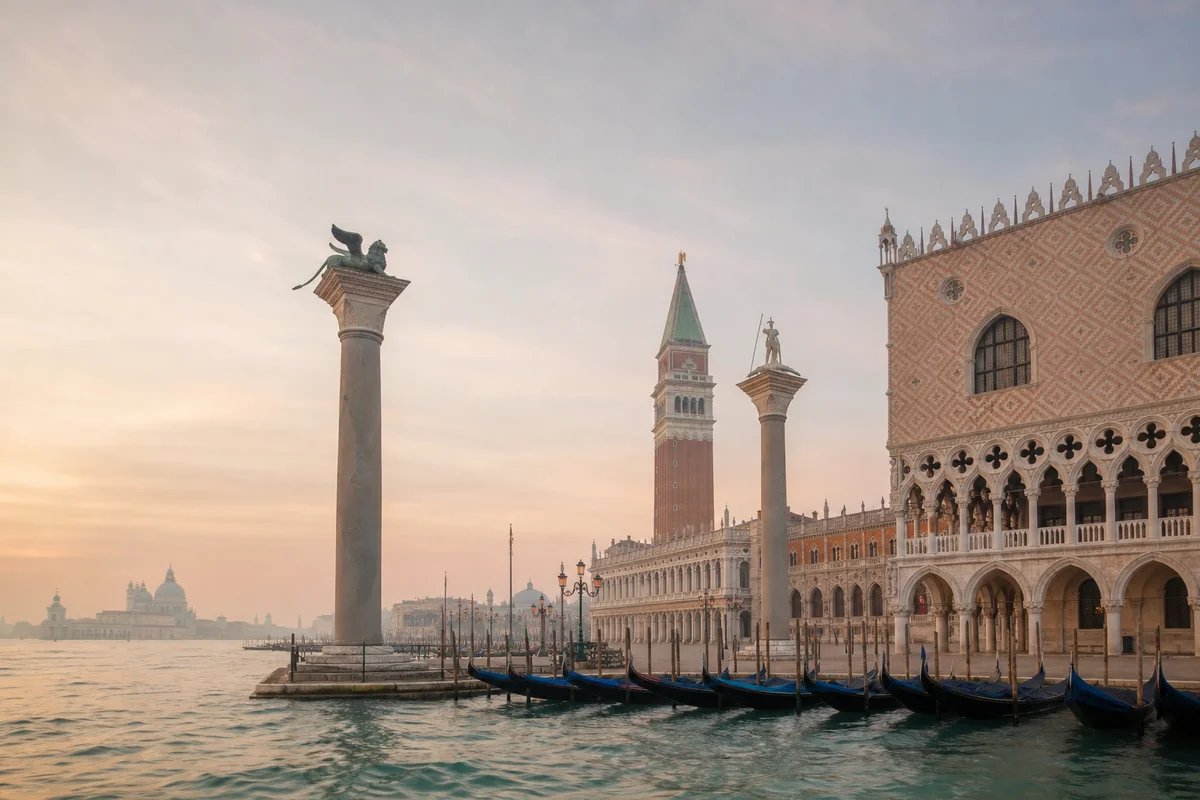
We start on the Piazzetta, by the two columns at the very edge of the water.
- City: Venice
- Route: 11 points
- Time: about 2 h
- Start: Venice, San Marco sestiere
- Format: self-guided, any day, no booking
What is on the route
The route points in order — what these places are and why they are interesting. Tasks and answers stay inside the quest.
Two columns — the gates of the republic — Columns of St Mark and St Theodore (Colonne di San Marco e San Todaro), Piazzetta San Marco
You are standing in the ceremonial gates of Venice. For five centuries everyone who arrived in the city by sea — an ambassador, a merchant, a king — came ashore right here and entered the Republic between these two columns.
The Doge's Palace — and the place where the worst was announced — Doge's Palace (Palazzo Ducale), loggia on the Piazzetta side
Turn your back to the water — in front of you is the Doge's Palace, a building that breaks every usual idea of how power ought to look. Usually a palace has a solid base and a light top.
Opening hours: usually daily 09:00–18:00 (summer) and 09:00–17:30 (winter); the ticket office closes an hour earlier; closed on 25 December and 1 January · Ticket: about 25–30 EUR (a combined ticket with the museums of St Mark's Square); better to buy the ticket online in advance
The Bridge of Sighs — the last view of freedom — Ponte della Paglia, view of the Bridge of Sighs (Ponte dei Sospiri)
Walk round the palace on its east side, to the embankment, and climb onto a low stone bridge — Ponte della Paglia, the Straw Bridge. The name is an honest one: barges loaded with straw used to moor here.
The Tetrarchs — a trophy that hugs — Monument of the Tetrarchs (Monumento ai Tetrarchi), south-west corner of the Treasury of St Mark's
Go back to the main entrance of the palace — to the Paper Gate, “Porta della Carta” — and look at the corner of the neighbouring building, the Treasury of the basilica, right down at ground level.
The basilica — a shop window of trophies — St Mark's Basilica (Basilica di San Marco), façade and loggia
Now stand in front of the façade of the basilica and let your eyes adjust. This building was not built — it was assembled.
Opening hours: usually Mon–Sat 09:30–17:15, Sun and holidays 14:00–17:15; on days with services access is limited, entry strictly by time slot · Ticket: entry to the basilica about 3–6 EUR; the museum with the original horses and the loggia is a separate ticket; book a slot online
The campanile — master of the house — St Mark's Campanile (Campanile di San Marco), Piazza San Marco
Step out onto the square and look at the bell tower. The Venetians call it “el paròn de casa” — master of the house: for centuries the city lived by its bells.
Opening hours: usually daily, about 09:30–21:15 in summer and 09:30–17:30 in winter; in a strong wind the ascent is closed · Ticket: about 10–15 EUR; a lift goes up
The Clock Tower — and the craftsmen who were blinded — Clock Tower (Torre dell'Orologio), Piazza San Marco
Cross the square to its north side, where the passage into the Mercerie shopping streets begins. Above the arch stands the Clock Tower, built at the very end of the 15th century to a design by Mauro Codussi.
Opening hours: inside the tower — a guided tour only, booked in advance, several sessions a day, including in English · Ticket: about 14–18 EUR; children under 6 are not admitted (steep stairs)
An optional pause: a bacaro in a courtyard — Osteria i Rusteghi, Corte del Tentor 5513, San Marco
An optional step — and the best moment for it is right now, halfway along. Walk under the Clock Tower into the Mercerie — the narrow trading slit along which Venice has gone from San Marco to the Rialto for a thousand years — and, before you reach Campo San Bartolomeo, duck into a gateway on the left.
Opening hours: usually from noon until evening; Sunday is often a closing day — check on the spot; the room is small · Ticket: a glass of wine about 4–8 EUR, cicchetti from 2–4 EUR each
Campo San Bartolomeo — the meeting place — Monument to Carlo Goldoni (Monumento a Carlo Goldoni), Campo San Bartolomeo
Come out of the gateway onto the small square at the very foot of the Rialto Bridge. This is Campo San Bartolomeo — the city's main meeting point: “vedemose al Goldoni”, let's meet by Goldoni, people say it here as casually as other cities say “by the fountain”.
The Rialto — the bridge that argued with Michelangelo — Rialto Bridge (Ponte di Rialto), Grand Canal
Climb up onto the bridge. For four centuries it was the only crossing of the Grand Canal — until the 19th century there was simply no other way to cross it on foot.
The Hunchback of the Rialto — the end of the course — The Hunchback of the Rialto (Il Gobbo di Rialto), Campo San Giacomo di Rialto
Come down off the bridge on the San Polo side and out onto the small square in front of the church of San Giacomo di Rialto — by tradition, the oldest in the city. You are in the real heart of Venice: not in ceremonial San Marco, but at the market this city grew out of.
Where to go next
This route is part of MeTravel city quests. Below are the other quests in this city and cities with quests nearby.
Quests in nearby cities
Travels: Venice
Traveller articles about this city will help round out the walk.