
MeTravel city quest
A quest through Milan: the city they rebuild from scratch
Milan: a free walking route “A quest through Milan: the city they rebuild from scratch” past the sights. Self-guided, any day, no booking. 10 points.
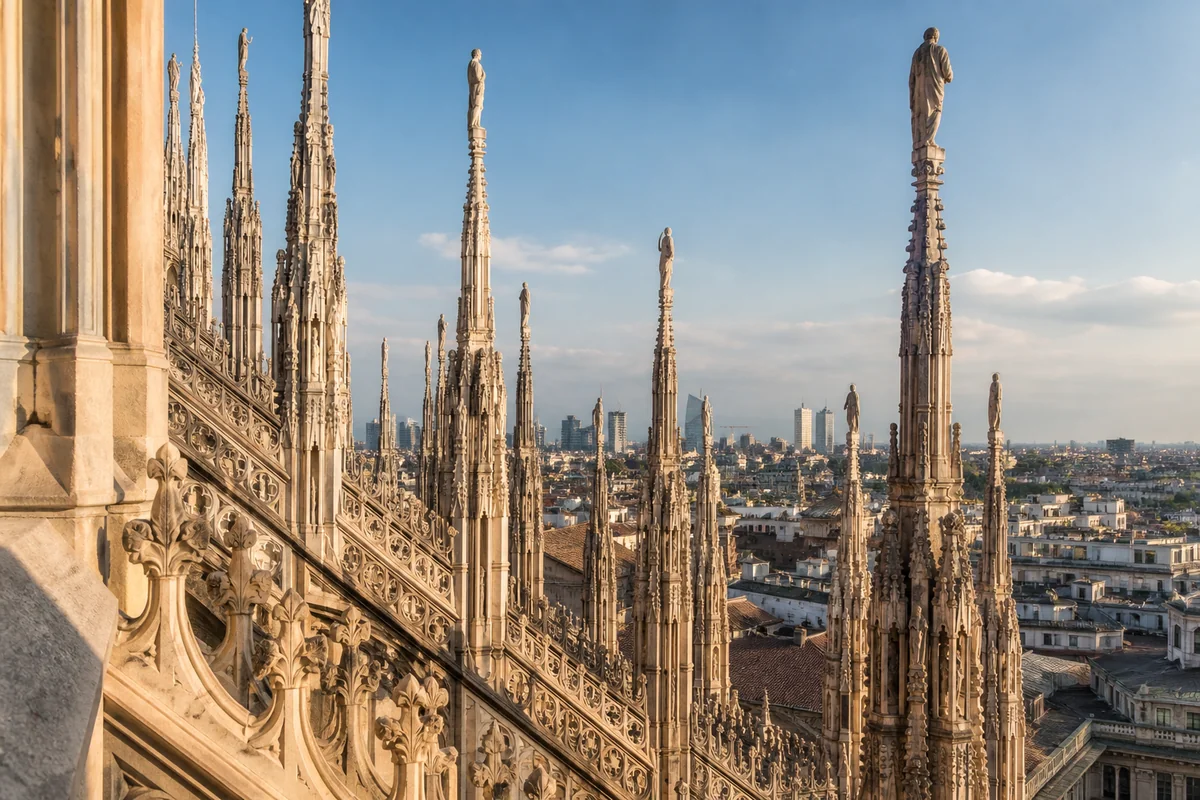
Milan gets a reputation as a boring city: money, fashion, offices, and all the beauty supposedly further south. The reputation is unfair, and the reason is simple — Milan is less well preserved than other cities because it has been smashed more often than they have.
The tally opens with Frederick Barbarossa, who took the city in 1162 and ordered it razed to the ground; the Milanese rebuilt, and twelve years later defeated the emperor at Legnano. In 1521 the powder magazine in the castle’s main tower blew up, and nothing was left of the tower. Napoleon carted paintings out of here by the wagonload. And in August 1943 the British air force burned out the centre in four nights: the theatre burned, the royal palace burned, a bomb punched through the wall of the refectory where “The Last Supper” hangs — the fresco survived by a miracle, under sandbags, while only two walls were left of the building around it.
And every time, the same thing happened. Milan did not turn the ruins into a memorial and did not stage mourning around them. It simply rebuilt — quickly, carefully, often “com'era, dov'era”, as it was and where it was. The theatre was restored in two years and opened with a concert that Toscanini came back for. The castle tower was recreated from old drawings. They raised the cathedral spire for six centuries, and raise it they did.
That is the Milanese character: not to complain, but to work. Today you will walk exactly along the traces of these losses and restorations — from the castle to the House of Giants — and along the way it will become clear why the locals take talk of southern beauty so calmly.
The route is about two kilometres, flat, some two and a half hours. We start at the main tower of Sforza Castle.
- City: Milan
- Route: 10 points
- Time: about 2 h 30 min
- Start: Milan, historic centre
- Format: self-guided, any day, no booking
What is on the route
The route points in order — what these places are and why they are interesting. Tasks and answers stay inside the quest.
The tower that was gone for three hundred and eighty years — Torre del Filarete, Castello Sforzesco, Piazza Castello
In front of you is the ceremonial entrance to Sforza Castle — a fortress rebuilt in the 1450s by Francesco Sforza, a condottiere who married the daughter of the last Visconti and in that way received Milan. The facade that faces the city was designed by the Florentine Antonio Averlino, nicknamed Filarete.
The last work they did not have time to finish — Museo della Pietà Rondanini, Castello Sforzesco
Walk under the tower into the castle courtyard and turn toward the former Spanish Hospital — there, in a separate empty room, stands one single sculpture.
Opening hours: the castle museums are usually open Tue–Sun 10:00–17:30, closed on Monday; the castle courtyard stays open longer and is free · Ticket: a single ticket to the castle museums is about 5–10 EUR; there are concession and free evening hours on certain days
Cordusio — from the ducal court to the banks — Piazza Cordusio
Leave the castle and walk along Via Dante — a wide pedestrian street cut through the old buildings at the end of the nineteenth century for the specific purpose of linking the castle with the centre.
Piazza dei Mercanti — medieval Milan in one piece — Piazza dei Mercanti
From Cordusio turn southeast, into a short little street — and you come to the only place in the centre where medieval Milan has survived as one whole piece. This was the city’s main square before the cathedral square became that: the court sat here, people traded here, sentences were read out here.
The Duomo — a building site six centuries long — Duomo di Milano, Piazza del Duomo
Another three hundred metres east — and there opens in front of you the thing people come to Milan for, even those who are sure that Milan is boring. The first stone was laid in 1386 under Gian Galeazzo Visconti.
Opening hours: the cathedral is usually open 09:00–19:00, the roof terraces 09:00–19:00 (last entry earlier); access is limited on days when services are held · Ticket: entry to the cathedral is about 10 EUR; the terraces on foot about 15 EUR, by lift about 20 EUR; a combined ticket costs more — buy it online
An optional stop: an aperitif where it was invented — Camparino in Galleria, Piazza del Duomo 21
An optional step, right at the entrance to the Galleria from the cathedral square — no need to turn off anywhere. This place opened in 1915, and Davide Campari opened it — the son of Gaspare Campari, who had invented his red bitter liqueur back in the 1860s in a neighbouring establishment on this same square.
Opening hours: usually daily from about 08:00 until midnight; the aperitif is served in the afternoon · Ticket: a glass at the counter is about 8–12 EUR, noticeably more at a table
The Galleria — and the heel that wore through the mosaic — Galleria Vittorio Emanuele II
Walk in under the giant triumphal arch and you are in a glass corridor. The Galleria was built in 1865–1877 to a design by Giuseppe Mengoni — soon after Italy was unified, when Milan wanted to mark that with something beyond dispute.
Piazza della Scala — and the man Milan considers its own — Piazza della Scala
Walk straight through the Galleria and come out on the other side — onto a small square laid out at the end of the nineteenth century. In its centre stands a white-marble monument, put up in 1872 to a design by Pietro Magni.
La Scala — two years from the ashes to Toscanini — Teatro alla Scala, Via Filodrammatici 2
Across the road from the monument stands a building at the sight of which visitors usually ask again: is this really it? Yes, it is.
Opening hours: the theatre museum is usually open daily 09:30–17:30; a view of the auditorium from a box is possible only if there is no rehearsal — otherwise they do not let you into the hall · Ticket: the museum is about 12–15 EUR; tickets for performances are sold well ahead, and cheap seats in the gallery go on the day of the show
The House of Giants — the finish — Casa degli Omenoni, Via degli Omenoni 3
The last two hundred metres: go round the theatre on the right and turn into a short lane named after the house you are walking to. The sculptor Leone Leoni built the building for himself — a pupil of Titian’s circle, court artist to Charles V, and head of the Milan mint.
Where to go next
This route is part of MeTravel city quests. Below are the other quests in this city and cities with quests nearby.