
MeTravel city quest
A quest through Florence: the city that commissioned its own Renaissance
Florence: a free walking route “A quest through Florence: the city that commissioned its own Renaissance” past the sights. Self-guided, any day, no booking.
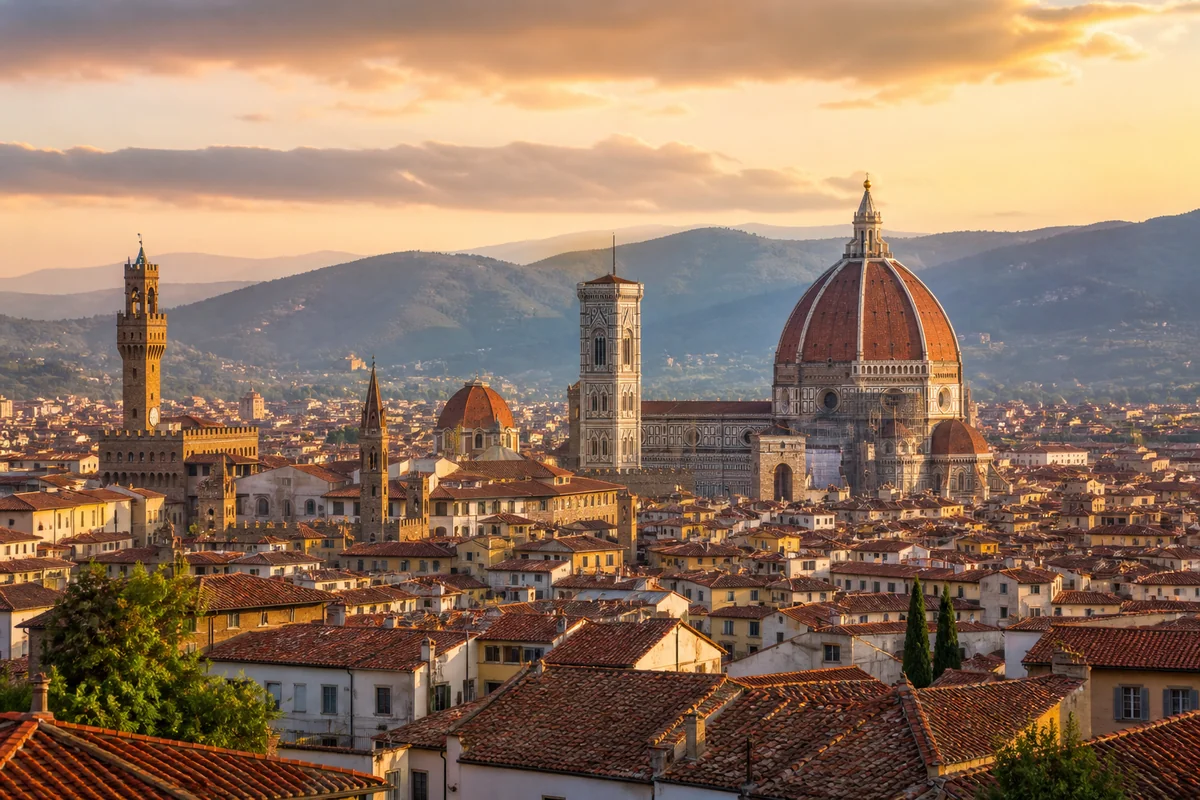
There is a convenient fairy tale: that in one fine century geniuses simply appeared in Florence of their own accord, and out came the Renaissance. On the spot, everything looks much more prosaic, and much more interesting.
The Florence of the 14th–15th centuries was not a court and not a principality, but a merchant republic governed by the guilds: associations of traders and craftsmen. Seven major ones — judges, money-changers, cloth merchants, wool merchants, doctors and apothecaries, silk merchants, furriers — and fourteen minor ones: butchers, shoemakers, blacksmiths, stonemasons, bakers. Each had its own coat of arms, its own statute, its own money and its own immoderate pride.
And these very guilds took upon themselves the upkeep of the city's main buildings. The wool guild answered for the cathedral. The Calimala guild, which traded in foreign cloth, for the baptistery. The money-changers, the furriers, the armourers, the bakers — for a shared church-granary. And then a simple human mechanism kicked in: if your neighbour and rival commissioned a statue from a good master, you were obliged to commission a better one. Competitions were announced in public, committees sat, and the losers took offence for life.
Out of this mixture of money, vanity and competition came the thing the whole world travels here for. The Renaissance in Florence was not a flash of inspiration, but a series of tenders.
Today you will walk through their results, from north to south: from the doors with which it all began to the bridge on which the guilds are still trading. The route is short — a little over a kilometre — but dense: there is something to look at here at every step. Better to go in the morning: in the daytime the centre is very crowded.
We start on Piazza del Duomo, by the octagonal building opposite the facade of the cathedral.
- City: Florence
- Route: 10 points
- Time: about 2 h 20 min
- Start: Florence, historic centre
- Format: self-guided, any day, no booking
What is on the route
The route points in order — what these places are and why they are interesting. Tasks and answers stay inside the quest.
The doors with which it all began — Battistero di San Giovanni, east doors, Piazza del Duomo
For centuries Florentines took the octagonal building in front of you for an ancient temple of Mars, rebuilt as a Christian one. In fact it was put up in the 11th–12th centuries, but the mistake was an honest one: the facing of white and dark-green marble really is very «Roman» in spirit.
Opening hours: the baptistery inside is usually 08:30–19:30; the hours change by season; the doors outside are always accessible, and free · Ticket: a combined ticket for the Duomo complex (baptistery, dome, campanile, museum) is about 30 EUR; the climb to the dome is by timed slot only
The dome nobody knew how to build — Cattedrale di Santa Maria del Fiore, Piazza del Duomo
Turn to face the cathedral. They began building it in 1296, to a design by Arnolfo di Cambio, and the wool guild, which was in charge of the building work, set the dimensions with room to spare for future greatness: what came out was an opening for a dome more than forty metres across.
Dante's lane, and an addressee people still write to — Chiesa di Santa Margherita dei Cerchi and Casa di Dante, Via Santa Margherita
Turn south from the cathedral, into the narrow lane of Via Santa Margherita. You are in the quarter where the houses of the Alighieri family stood.
Opening hours: the church is usually open in the daytime, admission free; the Dante's House museum is Tue–Sun, about 10:00–17:00 · Ticket: the church is free; the Dante's House museum is about 8 EUR
Orsanmichele — a showcase of guild vanity — Chiesa e Museo di Orsanmichele, Via dell'Arte della Lana
Come out through the lanes onto Via dei Calzaiuoli, the main pedestrian axis between the cathedral and the town hall, and find on the left a square building that looks nothing like a church. It was not conceived as a church either.
Opening hours: the church is usually open in the daytime, for free; the museum with the original statues upstairs runs to a timetable, more often in the second half of the week · Ticket: the church is free; the museum is about 8 EUR
An optional pause: gelato in a lane — Via dei Tavolini, the lane behind Orsanmichele
An optional step, and almost no detour: turn into the narrow lane of Via dei Tavolini, just behind Orsanmichele. One of the oldest gelaterias in the city has been working here since 1939.
Opening hours: usually Wed–Mon, about 12:00–20:00, Tuesday closed; longer in season — check on the spot · Ticket: a serving is about 3–6 EUR
Mercato Nuovo and a wet nose for luck — Bronze fountain at the edge of the Loggia del Mercato Nuovo
Go down through the lanes to the west, to an open loggia on columns. This is the New Market, built in 1547–1551 under Cosimo I for the trade in silk and gold wares — that is, for the wealthiest guilds in the city.
Palazzo Vecchio — and the beast with a coat of arms under its paw — Palazzo Vecchio, Piazza della Signoria
Come out onto Piazza della Signoria. This is the political heart of the republic: the government sat here, people gathered here for assemblies, and here too, in 1498, they burned Savonarola — the monk who for four years held the city in his power, arranged a «bonfire of the vanities» and ended on a bonfire himself.
Opening hours: the palace museum is usually 09:00–19:00, Thursday is shorter; the Arnolfo tower is on a separate ticket and closes earlier; in the rain they close the climb · Ticket: the museum is about 12–17 EUR, the tower separately; the square and the statues outside are free
Loggia dei Lanzi — a street museum in the open air — Loggia dei Lanzi, Piazza della Signoria
A few steps away, on the corner of the square, stands an open loggia with three wide arches. It was built in 1376–1382 for the public ceremonies of the republic: under it they received ambassadors and announced the decisions of the government.
The Uffizi courtyard — an office that became a museum — Piazzale degli Uffizi
Walk from the square into a long narrow courtyard running down towards the river. The word «uffizi» means exactly what it resembles — «offices».
Opening hours: the Uffizi Gallery is usually Tue–Sun 08:15–18:30, Monday closed; entry is by timed slot · Ticket: about 15–25 EUR by season, with reduced tickets; the first Sunday of the month is sometimes free — book online
Ponte Vecchio — the guild that is still trading — Ponte Vecchio, Florence
Come out of the courtyard to the river and turn right — it is about two hundred metres to the bridge. A bridge stood on this spot as far back as Roman times; the present one was built in 1345 after a flood had swept the previous one away.
Where to go next
This route is part of MeTravel city quests. Below are the other quests in this city and cities with quests nearby.