
MeTravel city quest
Brussels quest: the city that laughs at itself
Brussels: a free walking route “Brussels quest: the city that laughs at itself” past the sights. Self-guided, any day, no booking. 12 points.
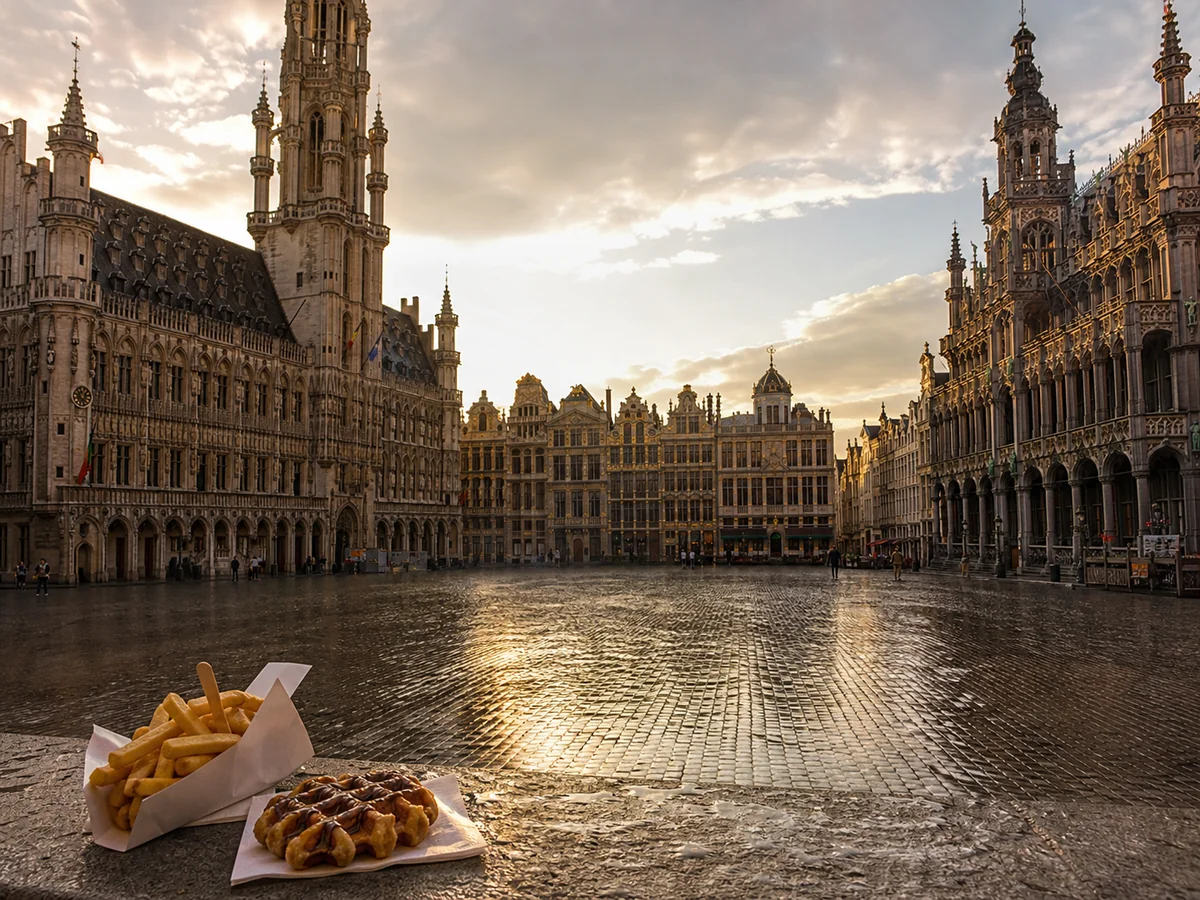
This city has two faces, looking in opposite directions.
One is grand. The European Union meets here, treaties are signed here, and every house is covered in gold on the square Victor Hugo called the world's most beautiful. The other face is mocking. The chief symbol of Europe's capital is a half-metre bronze boy who has been peeing into a fountain basin for four hundred years. The locals find nothing embarrassing about it: they sew him costumes, dress him to a schedule and keep an inventory of his wardrobe.
This habit has a name: zwanze. In Brussels dialect it means a particular kind of humour: laughing at yourself first, bringing all grandeur down to earth, letting no one — yourself included — get above themselves. Tourists did not invent it. It is a survival strategy for a city passed for centuries between Burgundians, Spaniards, Austrians, French, Dutch and Germans, burning, rebuilding and burning again.
Today you will cross Brussels from a bronze mongrel on a quiet street corner to a Gothic church on the antiques dealers' hill. Along the way are a square burned in three days and defiantly rebuilt; an iron cannonball lodged in an old church's pillar; Europe's first covered shopping arcade with a Latin motto; and a man the city has thanked for six hundred years by rubbing his bronze to a shine.
What to do: 1) Read the story and task at every stop. 2) Find the place on the map. 3) Look around and answer the question.
The route runs north-west to south-east: from the quiet Chartreux quarter to Sablon up the hill. On foot, without transport, about three and a half hours with stops. The first stop is the bronze mongrel at the corner of rue des Chartreux and rue du Vieux-Marché-aux-Grains.
- City: Brussels
- Route: 12 points
- Time: about 3 h 30 min
- Start: Brussels
- Format: self-guided, any day, no booking
What is on the route
The route points in order — what these places are and why they are interesting. Tasks and answers stay inside the quest.
The mongrel that got a monument — Corner of rue des Chartreux and rue du Vieux-Marché-aux-Grains, bronze dog
We begin not with a square or cathedral, but with a half-metre bronze mutt on a quiet street corner. It was installed in 1999: sculptor Tom Frantzen made it for the Chartreux neighbourhood committee, whose commission was honestly worded — “so tourists come to us too”.
The stock exchange that became a beer museum — Place de la Bourse, ceremonial staircase by the west façade
Head east towards the boulevard and you will reach the Lower Town's most pompous building. The stock exchange was built in 1868–1873 to Léon Suys's design on the site of a demolished Franciscan monastery.
Opening hours: Belgian Beer World inside the stock exchange: Mon–Thu and Sun 10:30–19:30 (last entry 18:30), Fri–Sat 10:30–20:30 (last entry 19:30) · Ticket: adult 21,50 €, children aged 12–15: 12 €, children aged 4–11: 8 €, up to age 3 free (information as of August 2026)
The cannonball lodged in a pillar — Saint-Nicolas Church, rue au Beurre, inside: third pillar on the left from the entrance
A hundred paces from the stock exchange, squeezed so tightly between shops that you can easily miss it, stands the centre's oldest church. Work on Saint-Nicolas began around 1125 — it is older than Grand-Place, older than the town hall, older than the very notion of a “capital”.
Opening hours: free admission; the church is usually open during the day, but avoid touring the interior during services
Half a metre of bronze holding up a country’s reputation — Corner of rue de l’Étuve and rue du Chêne, fountain in a stone niche
Now head south down rue de l'Étuve and you will see a crowd photographing something half a metre tall. Brussels sculptor Jérôme Duquesnoy the Elder cast the original in 1619, replacing a weathered stone figure that had stood here since at least the XV century.
Opening hours: GardeRobe MannekenPis costume museum (rue du Chêne 19, 100 m from here): Tue–Sun 10:00–17:00, closed Monday · Ticket: GardeRobe: around 5 € per adult, admission on the Brussels City Museum combined ticket (information as of August 2026)
The man the city has rubbed for luck for six hundred years — Arcade at the corner of rue Charles Buls, by Grand-Place’s south-western corner
Head north-east along rue Charles Buls to an arcade with a bronze relief in its wall. There is always a queue: people take turns touching the metal and making a wish.
The square burned in three days and rebuilt in four years — Grand-Place, north-western row of houses, No. 5 (between No. 4 and No. 6)
Step out of the arcade onto the square and stop. Victor Hugo, who lived in exile in Brussels, called Grand-Place the world's most beautiful square, and it is hard to argue.
Opening hours: Brussels City Museum in the King’s House (opposite the town hall, north-east side of the square): Tue–Sun 10:00–17:00, closed Monday. The original 1619 boy statuette is kept there · Ticket: around 10 € per adult, combined ticket with the costume museum (information as of August 2026)
Europe’s first covered arcade and two Latin words above its entrance — Southern portal of the Royal Saint-Hubert Galleries, entrance from rue du Marché aux Herbes
Walk north-east from the square towards rue du Marché aux Herbes and you will see a tall stone portal with a triangular pediment. Behind it begins the city's most elegant interior.
A break at “Sudden Death” tavern (optional) — À la Mort Subite, rue Montagne-aux-Herbes-Potagères 5–7
An optional stop, and the best resting place on the route: the climb to the Upper Town begins next, and it is worth setting off well fed. Walk through the galleries and leave at the northern end.
Opening hours: Mon–Sat 11:00–01:00, Sun 12:00–24:00 (information as of August 2026)
A cathedral dedicated to an archangel and a girl with a lantern — Cathedral of St Michael and St Gudula, main western entrance
Climb east and the entire white mass rises before you at once. The cathedral was built from 1226 to 1500: almost three centuries in which the Romanesque church on this hill became exemplary Brabantine Gothic.
Opening hours: Mon–Fri 07:30–18:00, Sat 07:30–15:30, Sun 14:00–18:00; main nave: free admission · Ticket: nave free; archaeological crypt and treasury charge a separate small fee
The staircase built for an exhibition — Mont des Arts, arch with the carillon clock above the staircase
Now walk south, uphill. Between the Lower and Upper Town lies Mont des Arts: stairs, a garden and a terrace overlooking half the city.
The royal square hiding an entire palace underneath — Place Royale, equestrian statue in the centre
Another hundred metres uphill brings you to a square that looks cut out of Paris and transplanted here. White façades, symmetry and porticoes: pure Neoclassicism from the 1770s, designed by Barnabé Guimard and Jean-Benoît Guimard for the Austrian governors.
Opening hours: Magritte Museum (place Royale 1): Tue–Fri 10:00–17:00, Sat–Sun 11:00–18:00, closed Monday. Underground Coudenberg Palace: entrance via BELvue museum, Tue–Fri 09:30–17:00, Sat–Sun 10:00–18:00 · Ticket: Magritte Museum around 13 € per adult; Coudenberg around 9 € (information as of August 2026; check the website)
The church built around a stolen sacred image — Church of Our Lady of Sablon, Grand Sablon square
The final stop is downhill and west towards Sablon square. This was once sandy waste outside the city wall (sablon means “sand”), where the poor were buried.
Opening hours: Mon–Fri 09:00–18:30, Sat–Sun 10:00–19:00; free admission
Where to go next
This route is part of MeTravel city quests. Below are the other quests in this city and cities with quests nearby.