
MeTravel city quest
Bruges quest: the city that slept for four hundred years
Bruges: a free walking route “Bruges quest: the city that slept for four hundred years” past the sights. Self-guided, any day, no booking. 11 points.
In the 15th century, Bruges was one of Europe's principal cities. The world's first exchange operated here — the word “bourse” came from the name of the Bruges Van der Buerse family, outside whose house merchants met. English wool, Italian silk, Hanseatic grain and Russian wax came here; Genoese, Venetian, Florentine, Spanish and German merchants kept offices here. Jan van Eyck and Hans Memling worked here. The dukes of Burgundy held weddings watched by all Europe.
Then it all ended. The Zwin inlet linking the city with the sea began silting up in the 14th century, and by the end of the 15th, ships could no longer reach it. Trade moved to Antwerp, much deeper and more convenient. Foreign offices left one after another. By the 19th century, Bruges was Belgium's poorest city: in 1892, the Belgian Georges Rodenbach wrote the novel Bruges-la-Morte about it — and the name stuck.
Here begins the paradox. While Antwerp, Ghent and Brussels tore down their Middle Ages to make room for factories and boulevards, Bruges simply had no money to demolish anything. The city stood untouched for four hundred years, like a forgotten room. In the 20th century, this turned out to be its greatest asset: in 2000, the entire historic centre of Bruges was added to the UNESCO World Heritage List.
Today, you will walk right through it: from a private replica of the Holy Sepulchre built by a family of Genoese merchants to a lake where, by an emperor's order, certain birds have had to swim for five hundred years. On the way, there will be a leaning belfry, a crusader relic, the only Michelangelo sculpture to leave Italy during his lifetime, and a brewery pumping beer through a pipe beneath the city.
What to do: 1) Read the story and task at each stop. 2) Find the place on the map. 3) Look around and answer the question.
The route runs from northeast to south, a little over two kilometres, about three and a half hours with museums and a break. We start in the quiet eastern quarter, at the Jerusalem Church on Peperstraat.
- City: Bruges
- Route: 11 points
- Time: about 3 h 30 min
- Start: Bruges
- Format: self-guided, any day, no booking
What is on the route
The route points in order — what these places are and why they are interesting. Tasks and answers stay inside the quest.
Jerusalem brought to Bruges in drawings — Jerusalem Church (Jeruzalemkerk), Peperstraat
We begin in a quiet quarter rarely reached by tour groups. Before you stands a very strange church — and there is an explanation for its strangeness.
Opening hours: Adornes estate and Jerusalem Church: usually Mon–Sat, closing early in the afternoon; tower and façade can always be viewed free from the street
The vanished harbour and the animal that became the city’s first citizen — Jan van Eyckplein, corner niche of the Poortersloge building
Head west along the canals to a square beside the water. Today, it is peaceful and planted with lime trees.
The belfry that has been falling for five hundred years — Markt square, entrance to the Belfort tower through the Cloth Hall courtyard
Walk south through the shopping streets to the city's main square. Above it rises what people come here for: an eighty-three-metre brick tower.
Opening hours: daily 09:30–18:00, last admission around 17:00; access to the top in limited groups, queues possible in summer · Ticket: about 15 € per adult, children under 17 cheaper or free (information as of August 2026; check the website)
A drop of blood brought back from a crusade — Burg square, façade of the Basilica of the Holy Blood with its external staircase
A hundred and thirty metres east brings you to Burg square. In the 9th century, Count Baldwin Iron Arm built the fortress around which the city grew; the enormous Saint Donatian's Cathedral stood here for a thousand years before the French demolished it in 1799.
Opening hours: daily 10:00–17:15; free admission to both chapels, small charge for the reliquary museum
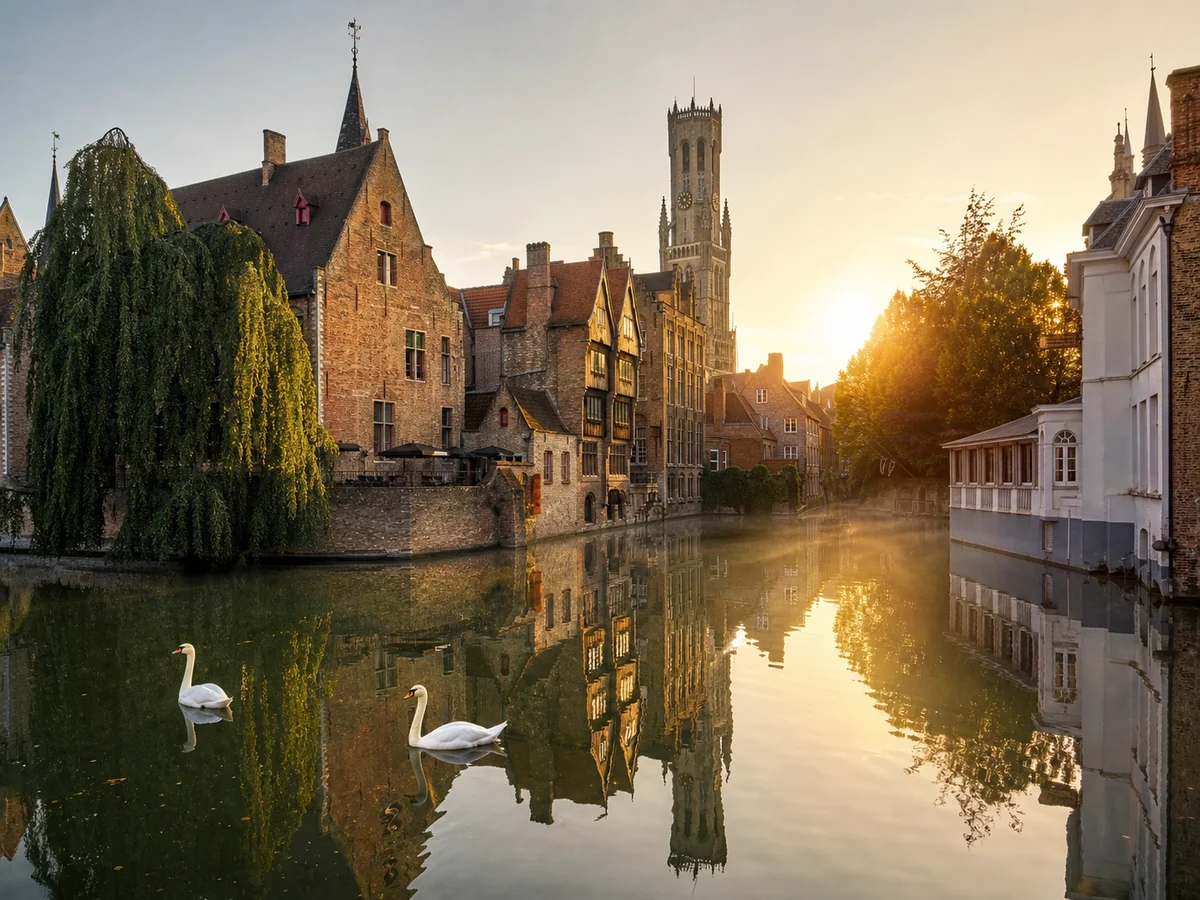
Belgium’s most photographed corner — Rozenhoedkaai waterfront, by the bend in the canal
A hundred metres south, towards the water. You are standing at the spot photographed more often than anywhere else in the country.
A palace built on beer herbs and a motto carved in stone — Gruuthuse Palace by Boniface Bridge, garden-side wall
Follow the water southwest to the city's cosiest corner. The little Boniface Bridge crosses the canal at a narrow point between garden and palace; it looks entirely medieval, yet it was built in 1910 because tourists found the detour inconvenient.
Opening hours: Gruuthuse Museum: Tue–Sun 09:30–17:00, closed Monday · Ticket: about 15 € per adult, free for under-17s (information as of August 2026; check the website)
The only Michelangelo to leave Italy in its creator’s lifetime — Church of Our Lady (Onze-Lieve-Vrouwekerk), altar in the south aisle
Fifty steps bring you to the foot of a brick tower a hundred and fifteen metres tall. This is the tallest brick tower in Benelux and one of the tallest brick structures in the world; it was built without a single load-bearing stone block, using brickwork alone.
Opening hours: church: daily 09:30–17:00; free admission to the nave, ticket needed for the museum section with the Madonna and dukes’ tombs · Ticket: museum section about 8 € per adult (information as of August 2026)
The hospital that worked for eight hundred years (optional) — Old Saint John’s Hospital (Sint-Janshospitaal), Mariastraat
Across the road from the church is an optional stop, one worth spending an hour on. Saint John's Hospital was founded in the 12th century and admitted patients until 1977 — eight hundred years of uninterrupted work, one of Europe's oldest surviving hospital complexes.
Opening hours: Tue–Sun 09:30–17:00, closed Monday · Ticket: about 15 € per adult, free for under-17s (information as of August 2026; check the website)
Break: a brewery with a pipeline beneath the city (optional) — De Halve Maan brewery, Walplein 26
Two hundred metres south brings you to the best place on the route to sit down. “The Half Moon” has brewed beer on this spot since 1856, and the Maes family runs the brewery in its sixth generation.
Opening hours: café-restaurant: Sun–Wed 11:00–17:00, Thu–Sat 11:00–21:00; brewery tours follow the schedule on the website · Ticket: tour about 18 € including tasting (information as of August 2026)
Women who were not nuns — Ten Wijngaerde Beguinage, stone bridge and entrance gates
A hundred metres brings you to a three-arched stone bridge over the canal. Beyond it are gates, and beyond those another world.
Opening hours: beguinage courtyard open daily approximately 06:30–18:30, free admission; beguine’s house museum Tue–Sun, small charge. Please keep quiet on the grounds
The Lake of Love and birds the city must keep forever — Minnewater, bridge at the southern end of the lake, beside the brick tower
The last three hundred metres lead south along the water, past the little lock house on the footbridge to the far end of the lake. You have reached Minnewater.
Where to go next
This route is part of MeTravel city quests. Below are the other quests in this city and cities with quests nearby.