
MeTravel city quest
Ghent quest: the city whose greatest painting was stolen
Ghent: a free walking route “Ghent quest: the city whose greatest painting was stolen” past the sights. Self-guided, any day, no booking. 11 points.
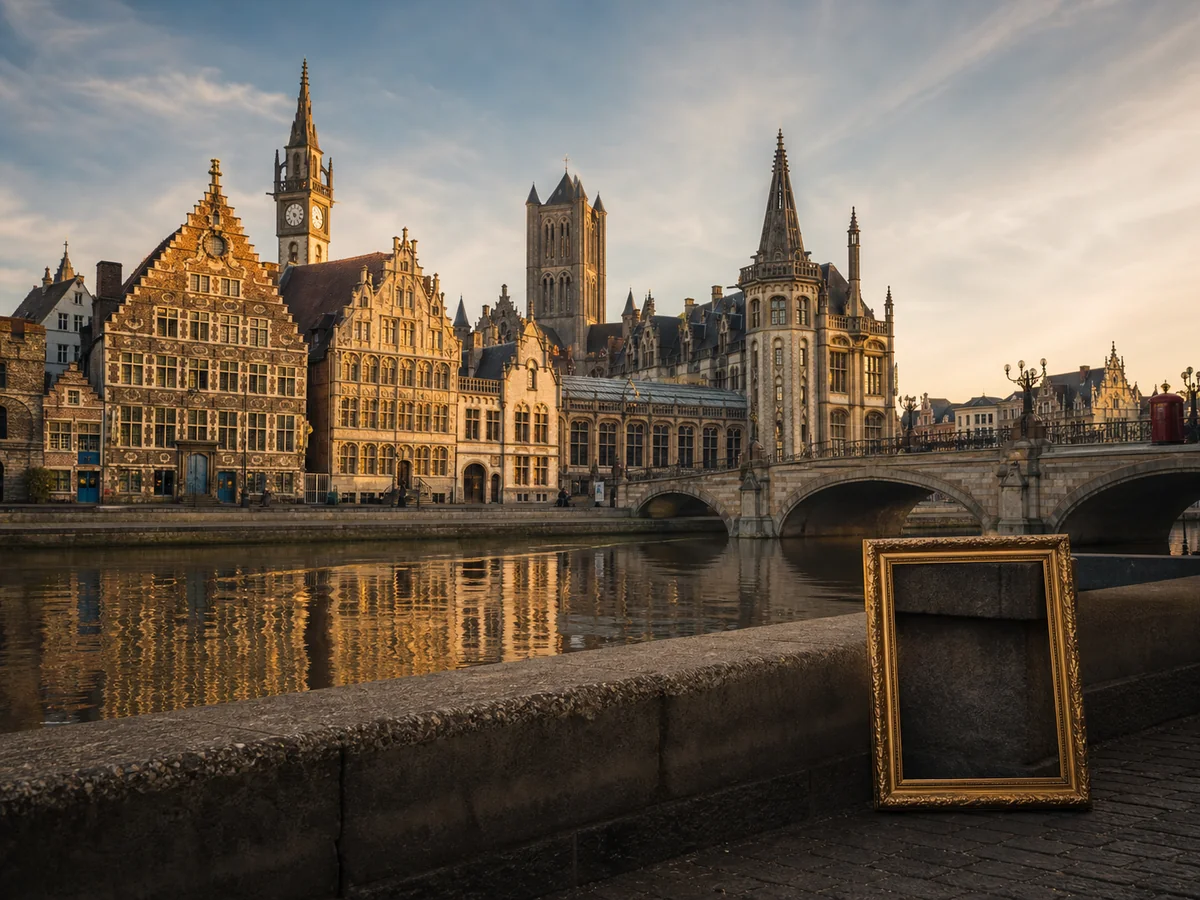
On the night of 10 April 1934, a wooden panel a metre wide and a metre and a half tall was carried out of Ghent's cathedral. It depicted horsemen: judges riding to worship the Lamb. A few days later, the diocese received a letter demanding a million francs, signed “D.U.A.”. The correspondence lasted six months, part of the ransom was paid, and the panel was not returned.
In November of the same year, the dying Ghent stockbroker Arsène Goedertier summoned a lawyer and said: “I alone know where the ‘Just Judges’ are. The secret is in a drawer of my desk.” In the drawer they found copies of the blackmailer's letters and a note with an unfinished sentence. The panel has still not been found. For more than ninety years, people have searched for it: lifting cathedral floors, scanning walls with ground-penetrating radar and digging in a park. In 1945, a copy painted by restorer Jef Van der Veken was put in its place — and it hangs there today.
That was just one theft among thirteen documented crimes against this painting in six hundred years. Calvinists tried to burn it; Napoleon's French troops carried it off; it was sawn up and sold in parts; the Germans took it away in the First World War under the Treaty of Versailles and again in the Second — to an Austrian salt mine, from which it was recovered in 1945. The Ghent Altarpiece is called the most stolen artwork in history, and that is no exaggeration.
The city it belongs to lives up to its painting. Ghent never submitted to anyone willingly: it rebelled against the counts of Flanders, French kings and its own emperor Charles V, who was born here. People are still proud of the nickname “noose bearers”: the city received it as a punishment and turned it into a celebration.
What to do: 1) Read the story and task at each stop. 2) Find the place on the map. 3) Look around and answer the question.
The route is short — a kilometre and a half — but packed: about three and a half hours if you go inside. We start at Saint Bavo's Cathedral, where it all happened.
- City: Ghent
- Route: 11 points
- Time: about 3 h 30 min
- Start: Ghent
- Format: self-guided, any day, no booking
What is on the route
The route points in order — what these places are and why they are interesting. Tasks and answers stay inside the quest.
The painting that began European painting — Saint Bavo’s Cathedral, chapel containing the Ghent Altarpiece
The cathedral was built from the 14th to the 16th century on the site of a 10th-century church. In its font, in 1500, a baby was baptised who would become Charles V — the emperor on whose domains the sun never set, and who later cruelly punished his native city for rebelling.
Opening hours: cathedral: daily approximately 10:00–17:00, Sunday from 13:00; the altarpiece chapel requires a separate ticket and timed admission · Ticket: altarpiece with augmented reality about 16 € per adult, free for children under 12 (information as of August 2026; check the website)
A prison door topped with something unexpected — Botermarkt, old city prison door in the corner of the Cloth Hall
Leave the cathedral and cross the square towards the tower. The eighty-nine-metre municipal belfry has stood here since 1313, topped with a gilded dragon — not an ornament but a declaration: the city is its own master.
Opening hours: ascent of the municipal belfry (lift + stairs): daily 10:00–18:00, last admission around 17:15 · Ticket: about 12 € per adult, considerably cheaper for under-18s (information as of August 2026)
The alley where everyone is allowed to paint — Werregarenstraat, narrow passage between Hoogpoort and Onderstraat
Walk north past the town hall, a building with two completely different façades. The northern side is late Gothic from 1519, stone lace covering the whole wall; the eastern side, along the other street, is smooth and austere.
The church that served as the city’s watchtower — Saint Nicholas’ Church (Sint-Niklaaskerk), Korenmarkt
Head southwest towards Korenmarkt — the Grain Market, the main crossroads of old Ghent. Here stands Saint Nicholas' Church, dedicated to the patron saint of merchants and sailors.
Opening hours: Mon 14:00–17:00, Tue–Sun 10:00–17:00; free admission
A bridge built for a single view — Sint-Michielsbrug over the Leie, middle of the span
Another hundred and fifty metres west brings you to a humpbacked stone bridge over the River Leie. Stand in the middle of the span and look east.
The harbour whose houses line up by height — Graslei waterfront, row of guild houses
Come down from the bridge onto the right bank and walk along the water. You are on Graslei — once Ghent's harbour.
The market where the city kept an eye on trade — Groentenmarkt, Great Butchers’ Hall (Groot Vleeshuis)
Head north towards the Vegetable Market. The long building with a tall tiled roof and stepped gables was built in 1407–1419 to a design by Gillis de Sutter, and served as the city's central market.
Opening hours: Tue–Sun approximately 10:00–18:00, closed Monday; free admission, tastings and café charged separately
The castle a count built against his own townspeople — Castle of the Counts of Flanders (Gravensteen), gate tower
A hundred metres north, in the middle of a residential district, without a hill or any warning, stands a real castle with battlemented walls and a moat.
Opening hours: daily 10:00–18:00, last admission around 17:15 · Ticket: about 13 € per adult, considerably cheaper for under-18s, audio guide included (information as of August 2026)
Break: the quarter saved from the bulldozers (optional) — Patershol, entrance from the Kraanlei waterfront
An optional stop and the best place on the route to sit down for a meal. You are at the entrance to Patershol, a maze of narrow cobbled lanes just behind the castle.
Opening hours: the quarter’s restaurants mostly open from 12:00 and from 18:00; many close on Monday and Tuesday, booking needed at weekends
The gun that never fired at an enemy — Grootkanonplein, giant cannon beside the water
Head southeast to a little square beside the canal. In its centre, a cast-iron tube more than five metres long and weighing about sixteen tonnes rests on a stand.
The square where the city decided its fate — Vrijdagmarkt (Friday Market), corner house with a turret
A hundred and fifty metres east brings you to old Ghent's largest square. Everything happened here.
Where to go next
This route is part of MeTravel city quests. Below are the other quests in this city and cities with quests nearby.