
MeTravel city quest
Antwerp quest: the hand thrown into the river
Antwerp: a free walking route “Antwerp quest: the hand thrown into the river” past the sights. Self-guided, any day, no booking. 11 points.
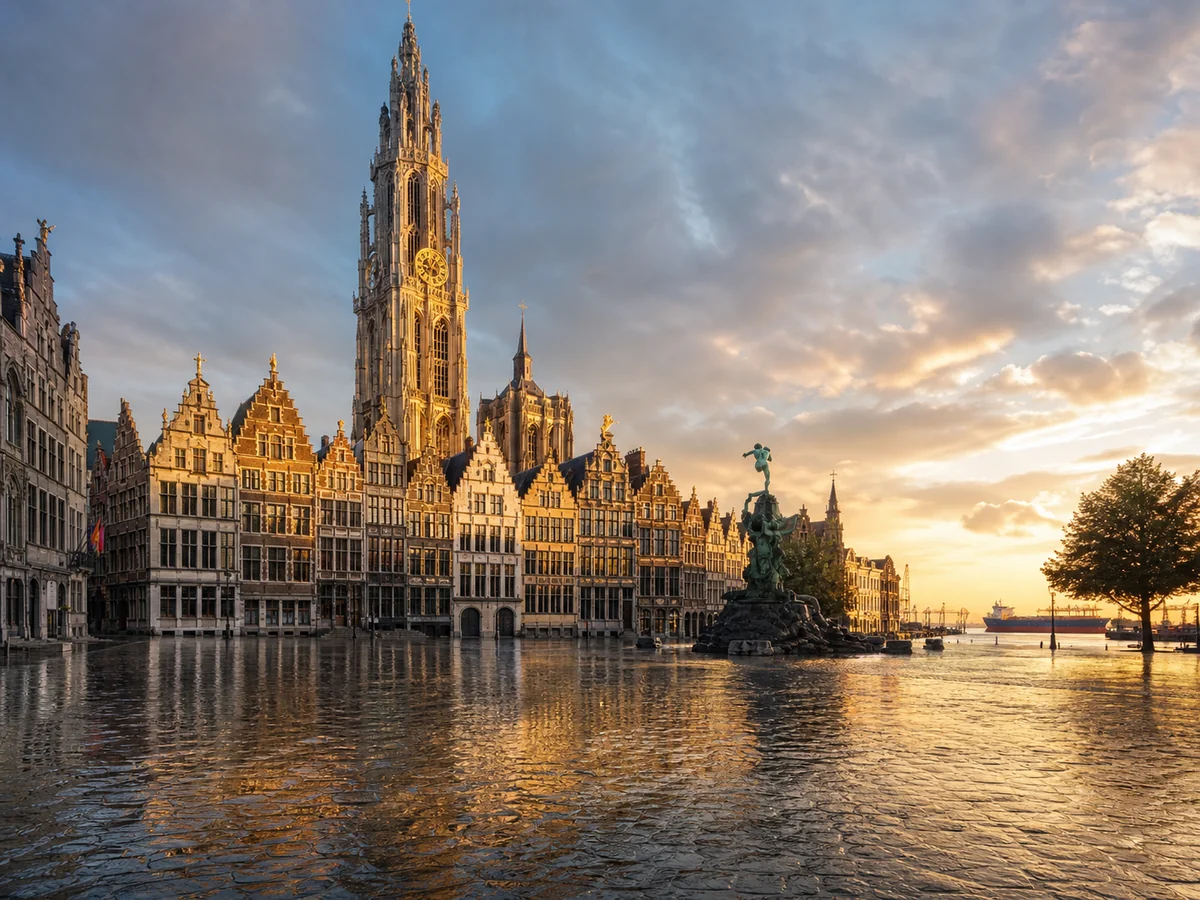
The legend explains the city's name like this.
A giant called Druon Antigoon lived on a bend in the Scheldt. He set up a toll station on the river and demanded half the cargo of every vessel. If someone refused to pay, the giant cut off their hand and hurled it into the water. This continued until a Roman soldier, Silvius Brabo, appeared. He challenged the giant, killed him, cut off his hand and threw it into the Scheldt, just as the giant had thrown other people's hands. In Dutch, “throwing a hand” sounds like hand werpen, and supposedly that gave the city its name: Antwerpen.
Philologists naturally disagree: the name most likely comes from aanwerp, “land washed up”, a sandbank on a river bend. But the townspeople are not bothered. The severed hand is everywhere here: on the coat of arms, on the fountain outside the town hall, on shop signs, in chocolate shops selling hand-shaped sweets, and on the main museum's facade, where there are several thousand of them.
Everything else in Antwerp is about the river too. The Scheldt made it Europe's second-largest port. In the XVI century, almost half of world trade passed through this harbour, the first proper stock exchange operated here, and ships sailed from here to India and America. Then the Dutch closed the river mouth for eighty years, and the city collapsed; then Napoleon built new docks, and the city rose again. Today, almost the entire global trade in rough diamonds passes through Antwerp.
Rubens lived here too: a painter, diplomat and owner of a studio run like a factory. Four of his altarpieces hang in the cathedral we will pass.
What to do: 1) Read the story and task at each stop. 2) Find the place on the map. 3) Look around and answer the question.
The route runs from southwest to north, a little over two kilometres, taking about three and a half hours. We start at the entrance to the pedestrian tunnel beneath the river.
- City: Antwerp
- Route: 11 points
- Time: about 3 h 30 min
- Start: Antwerp
- Format: self-guided, any day, no booking
What is on the route
The route points in order — what these places are and why they are interesting. Tasks and answers stay inside the quest.
The tunnel under the river and its old escalators — Entrance pavilion of the Sint-Annatunnel pedestrian tunnel, Scheldt waterfront
We start by the river, because this is where everything began. The Scheldt is broad and muddy here, the tides raise the water by five metres twice a day, and there are no bridges at all within the city.
Opening hours: the tunnel is open around the clock; escalators operate roughly 06:00–24:00; passage is free
The printing house that became the only museum on the UNESCO list — Plantin-Moretus Museum, Vrijdagmarkt
Head east into the courtyards towards Vrijdagmarkt. Behind an unassuming facade are the house, workshop and shop of a family that worked on this spot for three hundred years in succession.
Opening hours: Tue–Sun 10:00–17:00, closed Monday · Ticket: about 12 € for adults, reduced price under 25, free under 12 (August 2026 information; check the website)
A cemetery turned square, and a man who is not buried here — Groenplaats, bronze monument in the middle of the square
Two hundred metres east brings you to a spacious square beneath the cathedral. It did not become spacious straight away.
A break: the alley even the neighbours do not know about (optional) — Vlaeykensgang, entrance through the arch at Oude Koornmarkt 16
An optional stop and a good place to catch your breath before the cathedral. On Oude Koornmarkt, between shop windows and cafes, there is an inconspicuous arch at number 16.
Opening hours: the alley is freely accessible during the day; courtyard restaurants keep their own hours, and evening reservations are needed
The cathedral with half of it missing — Cathedral of Our Lady (Onze-Lieve-Vrouwekathedraal), west facade
Leave the alley and look up: above the rooftops rises the tallest Gothic tower in the Netherlands and Belgium, a hundred and twenty-three metres of openwork stone. Work on the cathedral began in 1352 and lasted a hundred and seventy years.
Opening hours: Mon–Fri 10:00–17:00, Sat 10:00–15:00, Sun 13:00–17:00 (access restricted during services) · Ticket: about 12 € for adults, free under 12 (August 2026 information; check the website)
Two sleepers in the paving — Handschoenmarkt, square by the cathedral’s west portal
The small triangular square at the cathedral entrance is called the Glove Market; gloves were once sold here. In one corner stands a well covered by an astonishing wrought-iron canopy: four iron rods rise to points, forged shoots curl between them, and at the very top a little bronze warrior swings a severed hand.
The square where a hand is thrown into the air — Grote Markt, between the fountain and the town hall
A hundred metres north brings you to the city's main square. At its centre stands the Brabo Fountain, installed in 1887 to a design by Jef Lambeaux.
The butchers’ hall that looks like a piece of bacon — Vleeshuis, corner of Vleeshouwersstraat
Head north along the narrow streets. After a hundred and fifty metres, a massive building rises before you, with corner turrets and a tall roof: the butchers' guild hall, built in 1501–1504 to a design by Herman de Waghemakere.
Opening hours: museum: Thu–Sun 10:00–17:00; on other days view the building from outside · Ticket: about 8 € for adults, reduced price under 25 (August 2026 information)
The city’s oldest building and what is above its gateway — Het Steen fortress, main gateway arch facing the waterfront
A hundred and thirty metres west, right to the water. This squat fortress of dark, rough masonry is Antwerp's oldest building: construction began around 1200 on the site of a IX-century fortification.
Opening hours: visitor centre inside: daily roughly 10:00–17:00; the gateway, figure and waterfront are outside and free at any time
The church with a stone Calvary in its courtyard — St Paul’s Church (Sint-Pauluskerk), courtyard with the stone garden
Three hundred metres northeast, into a neighbourhood with almost no tourists. St Paul's Church was built by the Dominicans in 1517–1571; the Baroque tower was added later, in 1680.
Opening hours: usually daily 14:00–17:00 in summer, shorter hours and not every day in winter; admission free, donations welcome
The red stone tower covered with thousands of hands — MAS Museum (Museum aan de Stroom), Hanzestedenplaats
The last seven hundred metres take you north, along the old docks into the Eilandje district. This was the city's first harbour, dug under Napoleon.
Opening hours: viewing terrace and escalator galleries: daily, free admission (until 22:00 in summer, shorter hours in winter). Museum galleries: Tue–Sun 10:00–17:00, closed Monday · Ticket: rooftop access free; museum galleries about 12 € for adults, reduced price under 26 (August 2026 information)
Where to go next
This route is part of MeTravel city quests. Below are the other quests in this city and cities with quests nearby.