
MeTravel city quest
Subotica — «The City That Bloomed»
Subotica: a free walking route “«The City That Bloomed»” past the sights. Self-guided, any day, no booking. 8 points. Approximately 1 h 40 min.
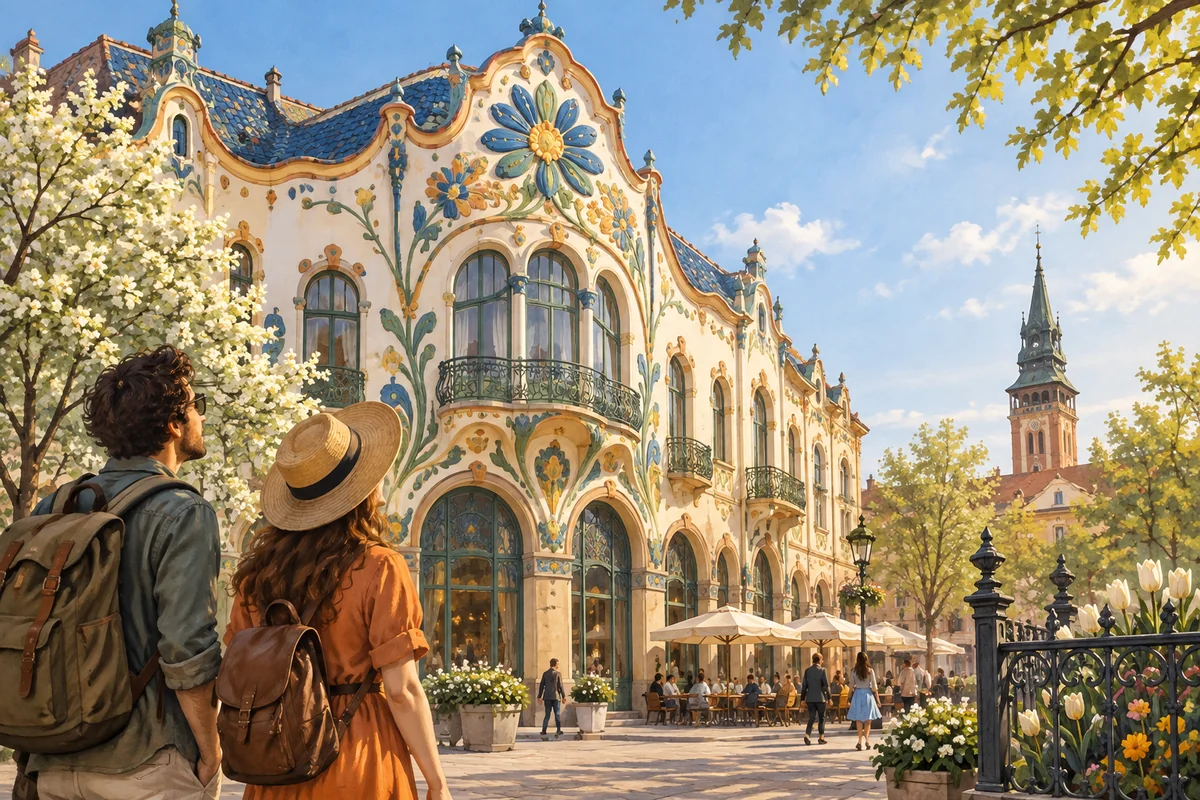
It seems someone mistook the city for a flower garden: leaves, petals, and unexpected lines have appeared on the houses. You are about to learn how the architects turned an ordinary walk into a close look at details. Collect eight observations: by the end of the route it will be clear why, here, you want to look up, not at your phone.
This is a walk with an exterior viewing: tickets and entry into the buildings are not needed to complete the tasks. Choose the daylight hours; do not block the passages, and respect the barriers.
- City: Subotica
- Route: 8 points
- Time: about 1 h 40 min
- Start: Subotica
- Format: self-guided, any day, no booking
What is on the route
The route points in order — what these places are and why they are interesting. Tasks and answers stay inside the quest.
Simeon Leović Palace, next to the Raichle Palace
Early Art Nouveau does not always shout with colour and stucco: sometimes it is enough to change the silhouette, calm the wall, and give it the even breath of brick.
Raichle Palace, Ferenc Raichle Park
An architect's own house let him speak in the first person: here Ferenc Raichle was building not for a client, but for himself, and so he allowed himself everything. The design appeared in 1903, and by 1904 the palace had already taken in the architect's family, his office, and several rental flats.
Palace of the Subotica Commercial Bank, Korzo 4
Even a business building could join the street's artistic conversation, and the bank on Korzo speaks at the top of its voice. The palace of the Subotica Trade Bank was built in 1907 to a design by Marcell Komor and Dezső Jakab — the same masters who signed the town hall and the synagogue.
National Theatre, Republic Square
Beside the wavy lines of the Secession, another architectural language is especially clear: strict classicism, with a heavy ceremonial entrance and a level pediment. The theatre opened in 1854 and is considered the oldest theatre building in Serbia, and the design was entrusted to János Skultéty, the first native of Subotica with an architectural education.
Town Hall, Freedom Square 1
The most conspicuous public building in the city turns decoration into an urban scale: a floral pattern spreads over the walls to the height of several storeys. The town hall was built from 1908 to 1912 to a design by Marcell Komor and Dezső Jakab, and its tower rose 76 m above the square.
Fountain by the town hall — Fountain on Republic Square by the town hall
The city's ceramics stepped beyond the facades and settled right on the square, by the ceremonial entrance to the town hall.
Synagogue, Jakab and Komor Square 6
Here the Secession turns to religious architecture and does not lower its tone: ceramics, coloured glass, and a plant pattern work at full strength. The synagogue was built in 1902 to a design by Marcell Komor and Dezső Jakab, who worked in the circle of Ödön Lechner, the father of Hungarian Art Nouveau.
City Museum, Synagogue Square 3
The building keeps up the conversation about the city even if you do not go inside today: the whole story is set out on the facade.
Where to go next
This route is part of MeTravel city quests. Below are the other quests in this city and cities with quests nearby.
Quests in nearby cities
- Нови-Сад
— 1 quest, 95 km
- Сремски-Карловци
— 1 quest, 102 km
- Печ
— 1 quest, 112 km
- Белград
— 1 quest, 158 km