
MeTravel city quest
Rzeszów: The golden brick and the secrets of the cellars
Rzeszów: a free walking route “The golden brick and the secrets of the cellars” past the sights. Self-guided, any day, no booking. 10 points.
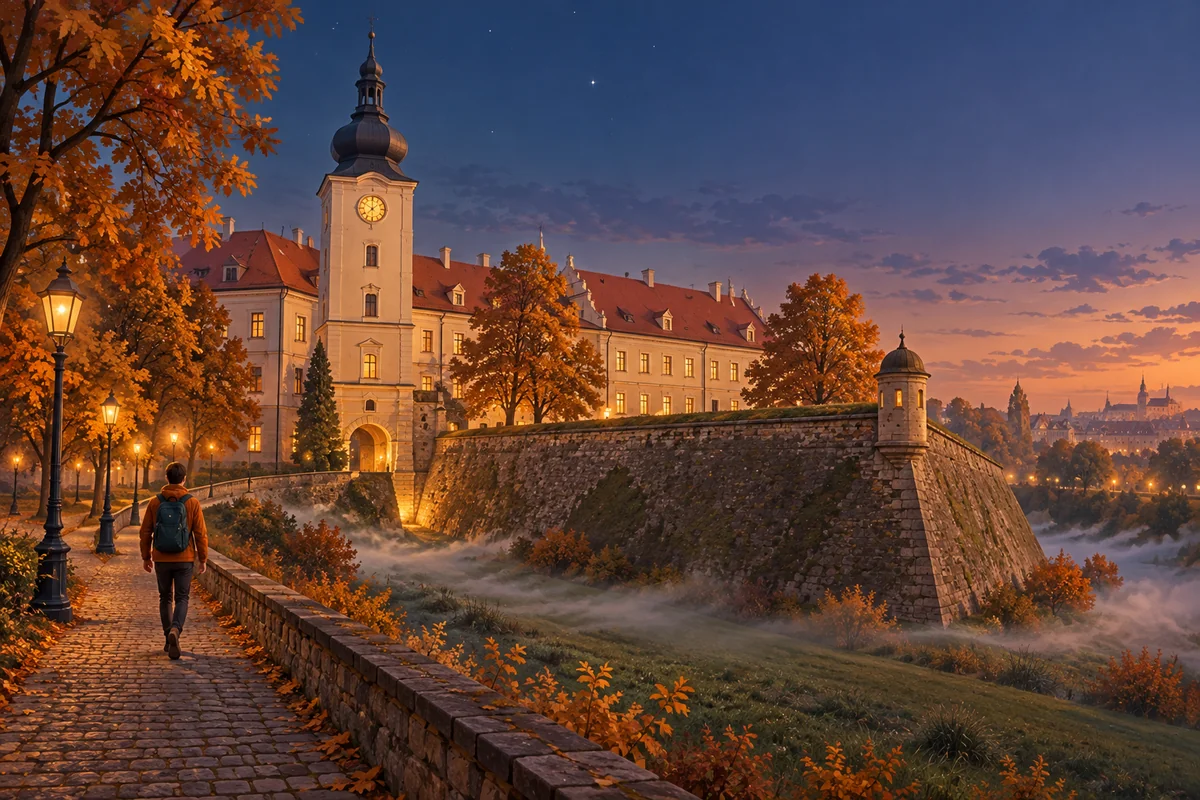
Every old city has a treasure of its own. People have searched for Rzeszów’s for four hundred years, and if the legend is right, everyone has looked in the wrong place.
The city grew on hills above the Wisłok River. In 1354 King Casimir the Great gave these lands to his diplomat Jan Pakosławic, and Rzeszów dates its history from that charter. At the turn of the 16th and 17th centuries, the magnate Mikołaj Spytek Ligęza became the owner of the city. Rich, devout and, people say, superstitious, he built on a grand scale: a church, a town hall and a castle above the river. The city’s favourite legend is about him and a golden brick that was meant to keep poverty away from the townspeople forever.
The brick is only one of its secrets. A whole underground city hides beneath the Market Square. A monastic treasure is said to lie within the walls of the church on the main street. Bronze and stone on the way to the castle hold clues to the whole history of Rzeszów, from a miraculous pear tree to the old name of the main street.
The route runs about a kilometre and a half through the centre, from the Bernardine monastery across the Market Square and along 3 Maja Street to the castle, with no backtracking. Allow an hour and a half to two hours. Dusk is the best time, when the streets and facades are lit up and the legends sound quite different. There’s a café halfway along where you can warm up.
Start by the stone column with the figure of the Virgin Mary at the corner of Cieplińskiego Avenue and Sokoła Street, beside the Bernardine monastery fence.
- City: Rzeszów
- Route: 10 points
- Time: about 1 h 50 min
- Start: Rzeszów, corner of Cieplińskiego Avenue and Sokoła Street
- Format: self-guided, any day, no booking
What is on the route
The route points in order — what these places are and why they are interesting. Tasks and answers stay inside the quest.
The Bernardine Madonna: the tree where it all began — Column by the Bernardine monastery fence, corner of Sokoła Street and Cieplińskiego Avenue
In front of you is a stone column topped by the Virgin Mary in a gilded crown with the infant Jesus in one arm. The column went up in 2010 to mark the 400th anniversary of the Bernardine monastery’s foundation.
Cellars under the square: a city beneath the city — Rynek 26, entrance to Rzeszowskie Piwnice by the town hall
Number 26 on the Market Square, next to the town hall, is the entrance to Rzeszowskie Piwnice, the underground route beneath the main square. From outside it looks like an ordinary old townhouse.
Opening hours: Tue–Sun 10:00–19:00, last entry 17:20. Closed Mon, 1 November and on major holidays. · Ticket: Guided (Tue–Fri) 35 zł, reduced 30 zł, family (2+2) 100 zł. Unguided (weekends) 25 zł, reduced 20 zł.
The town hall: a year encoded in stone — Town hall on the Market Square, side with a balcony above the arcades
Rzeszów’s white town hall, with its little clock tower, gables and balcony over three arches, is the most recognisable building on the Market Square. A stone town hall stood here as early as the late 16th century, when Mikołaj Spytek Ligęza owned the city.
Stary Piernik café: an optional break — Stary Piernik café, 9 Tadeusza Kościuszki Street
On Kościuszki Street, on the way from the square to the main street, the Grand Hotel building houses Stary Piernik, or “Old Gingerbread”. It is a café lounge with breakfasts, desserts and good coffee, with tables indoors and out.
Opening hours: Usually open daily from 9:00. Mon–Thu and Sun until 20:00, Fri–Sat until 21:00. Check the hours before visiting.
The Fara bell tower and a bronze bluesman — 3 Maja Street by the parish church bell tower (Fara)
Right below the Fara bell tower on 3 Maja Street, a bronze figure with long hair strides along the paving. This is Tadeusz Nalepa, known as the father of Polish blues.
The Piarist church: treasure in the tower — Church of the Holy Cross, 17 3 Maja Street
The white Church of the Holy Cross, with twin towers on its facade, is the heart of the former Piarist monastery on 3 Maja Street. There is a clock on the right-hand, south tower, and in the evening the whole facade is lit.
3 Maja Street: an old name underfoot — 3 Maja Street, pavement south of the Piarist church
3 Maja Street is Rzeszów’s main pedestrian street, running from the Fara almost to the castle. There are 19th-century townhouses, street lamps and flower beds along it, and in summer it is packed.
The Lubomirski Summer Palace: Rococo by the castle — Lubomirski Summer Palace, 2 Dekerta Street
Behind a fence with stone urns stands a pale palace under green mansard roofs, with a formal garden of clipped thuja in front. This is the Lubomirski Summer Palace, built a couple of hundred steps from the castle.
Jan Pakosławic: the knight who started the city — Jan Pakosławic monument by the castle ramparts, Aleja Pod Kasztanami
At the old castle bastions, on a granite pedestal with a bronze shield, stands a bearded knight with a sword and a long cloak. He is Jan Pakosławic of Stróżyska, the man with whom Rzeszów’s history as a city begins.
Ligęza’s castle: where the golden brick is hidden — Lubomirski Castle, Plac Śreniawitów, by the gate tower
In front of you is Lubomirski Castle, with a slender gate tower and clock, long buildings under a red roof, and massive corner bastions above a dry moat. It houses the Regional Court, so you can go inside only on rare guided tours.
Where to go next
This route is part of MeTravel city quests. Below are the other quests in this city and cities with quests nearby.
Quests in nearby cities
- Сандомир
— 1 quest, 74 km
- Нова-Слупя
— 1 quest, 113 km
- Замосць
— 1 quest, 117 km
- Кельце
— 2 quests, 133 km