
MeTravel city quest
A Bodrum quest: knights, the Mausoleum and the stones of Halicarnassus
Bodrum: a free walking route “A Bodrum quest: knights, the Mausoleum and the stones of Halicarnassus” past the sights. Self-guided, any day, no booking.
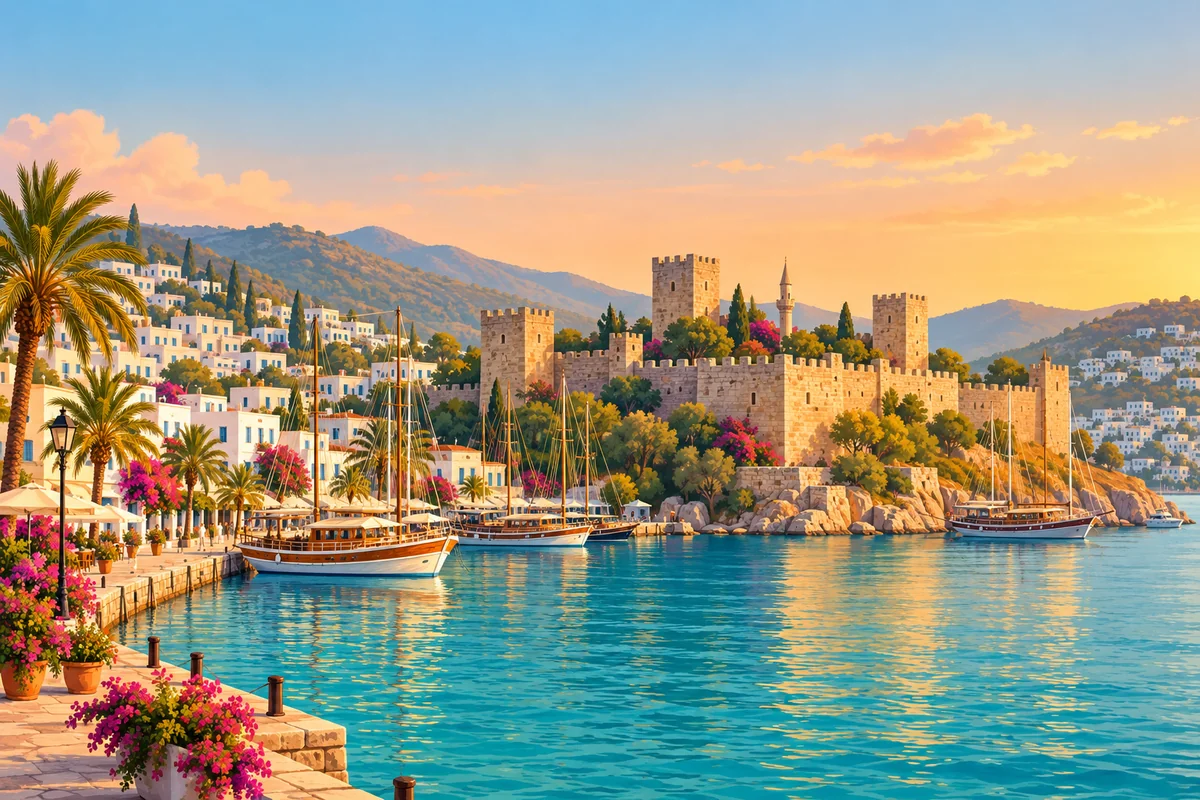
More than two thousand three hundred years ago, the site of Bodrum was occupied by Halicarnassus — the capital of Caria, the city of King Mausolus. A tomb of such beauty was built here for him and his wife Artemisia that the Greeks included it among the seven wonders of the world, and the king's name became the word “mausoleum”. Herodotus, known as the father of history, was also born here.
Then came the earthquakes, and the wonder of the world collapsed into a heap of marble. In the early XV century the Knights of St John, the Hospitallers, landed on the headland by the harbour and began building the Castle of St Peter. The building material lay close at hand: the blocks and reliefs of the Mausoleum. By 1522 almost nothing remained of the tomb — it had gone into the castle walls or the lime kilns.
In three hours you will walk this whole journey from antiquity to the present: from the city gate stormed by Alexander the Great, past the theatre and the site of the Mausoleum to the marina, where monuments to sponge divers and a poet sit, on to statues of the king and queen, the castle, and the quiet bay where Turkey's most famous singer lived.
What to do: 1) Read the story and task at each stop. 2) Find the place using the map. 3) Look around and answer the question.
The route is about 3.5 km on foot, with one climb to the theatre. The theatre is closed on Mondays, but its task can also be completed from outside. Halfway along the route there is a break at a café by the castle. We begin on the western edge of the old town, at the gate through which the road to Myndos once ran.
- City: Bodrum
- Route: 10 points
- Time: about 3 h
- Start: Bodrum, the western edge of the old town
- Format: self-guided, any day, no booking
What is on the route
The route points in order — what these places are and why they are interesting. Tasks and answers stay inside the quest.
The gate where Alexander was stopped — Myndos Gate (Myndos Kapısı), the path through the remains of the gate
The Myndos Gate was the western entrance to ancient Halicarnassus: from here the road led to the neighbouring town of Myndos at the end of the peninsula, now Gümüşlük. The wall and gate were built in the IV century BC under King Mausolus, using large dressed blocks, with a deep moat dug in front.
A theatre for ten thousand spectators — Bodrum Ancient Theatre, entrance from Kıbrıs Şehitleri Street
The ancient theatre of Halicarnassus rests against the southern slope of Göktepe hill, above Bodrum's main ring road. It was built in the IV century BC and, according to Turkey's Ministry of Culture, its rows held around ten thousand spectators.
Opening hours: Tue–Sun 08:30–17:30; ticket office until 17:00; closed on Mondays · Ticket: free admission
An empty site where a wonder once stood — Mausoleum Museum (Mausoleion), entrance from Turgutreis Street
Beyond the museum fence lie a pit, fragments of columns and steps: all that remains on the site of the Mausoleum. Mausolus, ruler of Caria, began building the tomb for himself.
Opening hours: Tue–Sun, approximately 08:30–17:00 (closed on Mondays); hours vary by season — check muze.gov.tr · Ticket: paid admission at Turkey's Ministry of Culture rate; MüzeKart is accepted
The man who walked on the seabed — Marina waterfront, the lawn beside the footpath, the bronze sculpture “Dalgıç”
The plaque beside it says it is the work of sculptor Yavuz Tanyeli, donated to Bodrum by Gülin and Akın Öngör in 2000. The diver has no face: the sculptor left only what fish would have seen on the seabed.
The poet who spoke through a reed — Marina waterfront, the bronze monument to a poet on a stone plinth beside a semicircular bench
A bronze man with a thick head of hair sits on a stone with one leg tucked beneath him. This is Tevfik Kolaylı, a poet and composer: he was born in Bodrum in 1879, and the street along the marina was named after him.
The queen who outwitted her neighbours — Old market square (Çarşı), two marble statues on plinths among the café tables
In the middle of the old market square, among the tables and parasols, stand two figures in long, draped robes: Artemisia and Mausolus. They are copies of the colossal statues found by Charles Newton on the site of the Mausoleum.
A break: the sailors' café by the castle (optional) — Denizciler Derneği café, Müftü Yakup Önes Caddesi 44, the square at the foot of the castle
Denizciler Derneği café belongs to Bodrum's sailors' association and stands right on the square by the castle, facing the harbour. Old gulet captains drink tea here in the mornings, while tourists sit at neighbouring tables with ice cream and homemade lemonade.
Opening hours: daily from early morning until late at night; hours may be shorter in winter
A fortress built from the blocks of a wonder — Castle of St Peter, the forecourt by the round tower, before the turnstiles
The Castle of St Peter occupies the entire rocky headland between Bodrum's two bays. The Knights of St John began building it in 1402–1404 under the German knight and architect Heinrich Schlegelholt.
Opening hours: daily 08:30–17:30; ticket office until 17:00 (winter timetable; the castle stays open longer in summer) · Ticket: 20 € for foreign visitors aged 8 and over (also payable in lira at the exchange rate); children under 8 free; MüzeKart is available to Turkish citizens
The woman whose hair is the sea — Kumbahçe bay waterfront, the sculpture on a white plinth right by the water
On the eastern waterfront, right by the water, a ceramic woman reclines on a white stone plinth. Her hair is long and wavy, flowing towards the sea like the surf.
The home of the Sun of Art — Zeki Müren Art Museum, the wrought-iron gates with a sign on the slope above the waterfront
Wrought-iron gates with a Ministry of Culture sign, stone steps among greenery, and a white house on the slope — this was the home of Zeki Müren, the singer known in Turkey as the “Sun of Art”. The plaque on the wall says that the artist bequeathed his entire fortune to the Mehmetçik Foundation and the Turkish Education Foundation.
Opening hours: Tue–Sun, closed on Mondays; hours vary by season — check muze.gov.tr · Ticket: paid admission at Turkey's Ministry of Culture rate; MüzeKart is accepted
Where to go next
This route is part of MeTravel city quests. Below are the other quests in this city and cities with quests nearby.