
MeTravel city quest
An Orsha quest: Karatkevich, the collegium, and the town where the Dnieper meets the Orshitsa
Orsha: a free walking route “An Orsha quest: Karatkevich, the collegium, and the town where the Dnieper…” past the sights. Self-guided, any day, no booking.
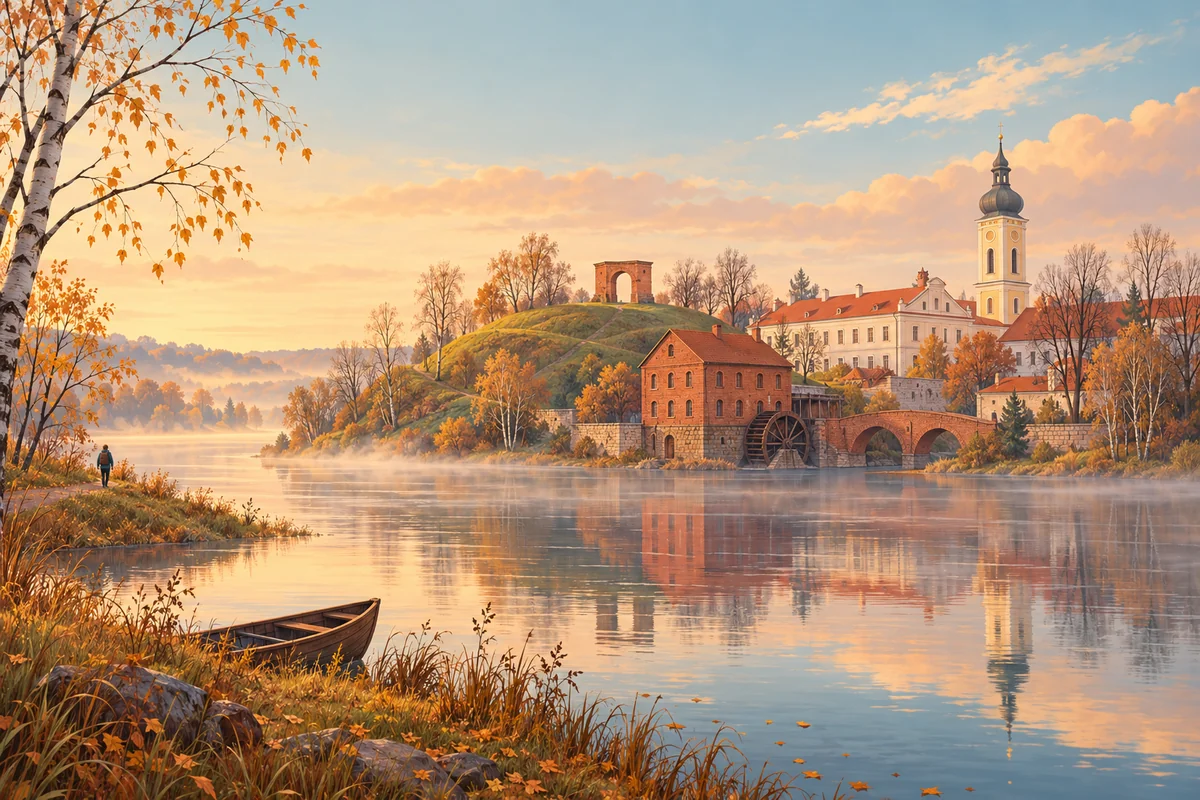
Orsha stands where the little Orshitsa flows into the Dnieper. On the cape between the two rivers a wooden town grew up almost a thousand years ago, and already in the XI century the chronicler of the “Tale of Bygone Years” wrote down its old name — “Рша”. Since then the town has seen a castle from the time of Vytautas, a Jesuit school where Napoleon stayed, one of the largest mills in the province, and the war that reached here in the summer of 1941.
In November 1930 a boy was born here who would later gather all of this into words — Uladzimir Karatkevich. His grandfather told him old Belarusian legends, and the boy grew up a romantic writer: almost everyone in Belarus knows his “King Stakh’s Wild Hunt”. Of Orsha he wrote: “Орша — мой любы горад, мая спрадвечная маці”. The route passes the places he knew from childhood, and legends meet you at every step — beginning with how the river got its name.
What to do: 1) Read the story and the task at each point. 2) Find the place on the map. 3) Look around and answer the question.
The route is about 2.6 km on foot, two to two and a half hours with stops, and no transport. We start in Zaorshitsa, on the right bank of the Orshitsa, then climb by the bridge to Zamchyshcha, pass the mill and the collegium, call at Karatkevich’s house, and cross the Dnieper bridge to the left bank. Both river crossings are ordinary town bridges. The museums are open Tuesday to Sunday from 10:00 to 18:00 and closed on Monday. In winter it gets dark early, so set out before lunch; there is a warm stop in the middle of the way.
- City: Orsha
- Route: 9 points
- Time: about 2 h 30 min
- Start: Orsha
- Format: self-guided, any day, no booking
What is on the route
The route points in order — what these places are and why they are interesting. Tasks and answers stay inside the quest.
The church beyond the Orshitsa — 6 Sovetskaya Street, in front of the main facade of St Joseph’s church
The pale church of St Joseph stands on the right bank of the Orshitsa, in old Zaorshitsa, and faces Sovetskaya Street with its main facade. The facade is severe, with pilasters and flat niches: baroque and classicism are mixed in it.
The hill where the rivers meet — Zamkovaya Street, the top of the Zamchyshcha hillfort, the brick memorial gates
Zamchyshcha is a high grassy hill on the cape where the Orshitsa flows into the Dnieper. On the summit stand symbolic brick gates with an arch, and from the slopes you can see both rivers at once.
The red mill on the canal — 2a Zamkovaya Street, the end of the mill facing the Red Bridge
A tall mill of red brick stands right above the canal that joins the Orshitsa to the Dnieper. Under a wooden shelter by its wall is a large water wheel, and a humpbacked Red Bridge leads to the Zamchyshcha hill across the old castle moat.
Opening hours: Tue–Sun 10:00–18:00 with no break, ticket office and tour bookings until 17:30; Mon and public holidays closed · Ticket: 3.40 BYN, pupils and students 2.80 BYN, children under 7 free; free entry on the last Wednesday of the month (prices from 1 March 2026)
A school, a prison, and a gallery — 6a Lenin Street, the square in front of the clock tower
The long white building with a red roof and a tall tower is the former Jesuit collegium, the landmark of Orsha. The tower rises over the central square, and on its upper tier the clock faces can be seen from every side.
Opening hours: Tue–Sun 10:00–18:00 with no break, ticket office and tour bookings until 17:30; Mon and public holidays closed · Ticket: 3.40 BYN, pupils and students 2.80 BYN, children under 7 free; free entry on the last Wednesday of the month (prices from 1 March 2026)
A stop in the collegium (optional) — 6a Lenin Street, the “Замковое” cafe inside the collegium
The “Замковое” (“Zamkovoye”) cafe works right inside the former collegium, so you do not have far to walk. This is the warmest place on the route: you can wait out the frost, drink something hot, and eat.
Opening hours: daily from 12:00, on Friday and Saturday until midnight, on other days until 22:00 (map data, confirm on the spot)
The house where the writer was born — 26 Lenin Street, the porch of the Karatkevich museum
The low pale house, with white stucco window frames and a wrought-iron canopy over the porch, was built at the turn of the XIX and XX centuries. From 1925 it was the town maternity hospital, and on 26 November 1930 Uladzimir Karatkevich was born in it.
Opening hours: Tue–Sun 10:00–18:00 with no break, ticket office and tour bookings until 17:30; Mon and public holidays closed · Ticket: 3.40 BYN, pupils and students 2.80 BYN, children under 7 free; free entry on the last Wednesday of the month (prices from 1 March 2026)
A writer with a pen by the Dnieper — the children’s park on the Dnieper bank, the Karatkevich monument, the scroll plaque on the pedestal
In the park on the bank of the Dnieper stands a bronze bust of the young Karatkevich on a granite pedestal. The writer holds a pen over an open book, and the book lies on the cut end of a log with its growth rings.
The salvo by the Dnieper — the left bank of the Dnieper by the Mogilev Street bridge, the “Катюша” memorial, the black cube at the entrance
The memorial stands on the high left bank of the Dnieper, just past the bridge. In the center, on a granite pedestal, is a rocket launcher on a truck of the 1941 model, and beside it six white concrete rails set at a slope: together there are seven, the same number of vehicles as in the experimental battery.
A view of the cape where it all began — Ilyinskaya Street, the fence of the Holy Elijah church above the Dnieper
The white-and-blue Holy Elijah church, with blue domes, stands behind a white fence on the left bank of the Dnieper, opposite the mouth of the Orshitsa. The brick church was built in 1880 on the site of an old wooden one, and since 1996 a convent has lived here again.
Where to go next
This route is part of MeTravel city quests. Below are the other quests in this city and cities with quests nearby.
Quests in nearby cities
- Могилёв
— 6 quests, 68 km
- оз. Хотомля (Круглянский район)
— 1 quest, 75 km
- Витебск
— 7 quests, 78 km
- Смоленск
— 1 quest, 109 km
Travels: Orsha
Traveller articles about this city will help round out the walk.