
MeTravel city quest
A quest through Paphos: the capital at the edge of the sea
Paphos: a free walking route “A quest through Paphos: the capital at the edge of the sea” past the sights. Self-guided, any day, no booking. 9 points.
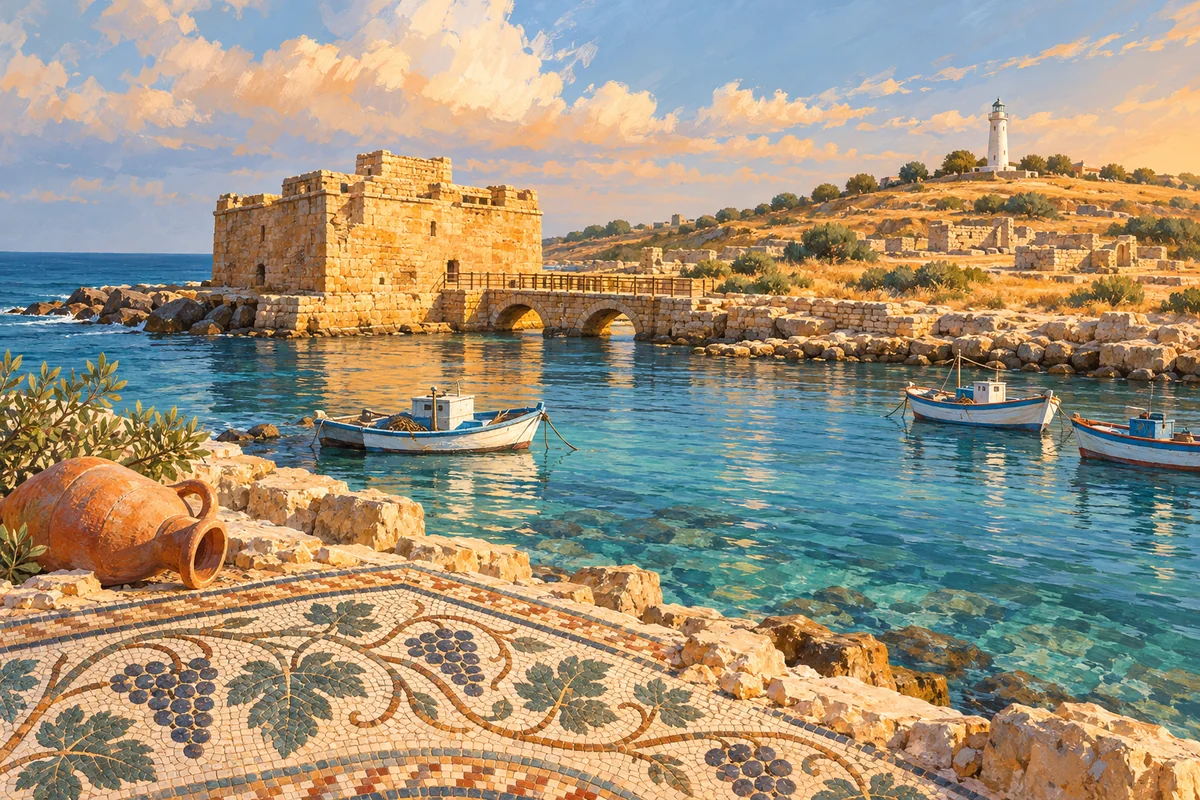
Paphos has two lives and two addresses. Old Paphos, Palaepaphos, stood sixteen kilometres to the east, by the present-day village of Kouklia: the sanctuary of Aphrodite was there, and pilgrims came from all over the Mediterranean. Farther along the coast, at the rock of Petra tou Romiou, the goddess, the legend says, rose from the sea foam. At the end of the 4th century BC the last king of Old Paphos, Nicocles, moved the city here, to a convenient bay — and that is how Nea Paphos, New Paphos, came to be.
The new city soon outgrew the old one. The Ptolemies, who ruled Egypt, made it the capital of the whole of Cyprus: Alexandria is not far, and the harbour is large. Under the Romans the proconsul lived here — the governor of the island — and the city carried the honorary names of Augustus and Claudius. For about six centuries Paphos remained the chief city of Cyprus, until the earthquakes of the 4th century ruined it and the capital moved to Salamis.
Then came Arab raids, crusaders, Frankish kings, Venetians, Ottomans, and the British — and each left a layer here. Today the whole of Nea Paphos is on the UNESCO World Heritage List, and those layers lie on a patch a couple of kilometres across.
What is waiting for you is a capital read from the sea inland: the fort by the harbour, Roman villas with mosaics, a hill with a British lighthouse, an ancient concert hall, a fortress an earthquake brought down — and the place where, according to the Acts of the Apostles, the Roman governor of the island first came to believe.
What to do: 1) Read the story and the task at each stop. 2) Find the place on the map and walk up to it. 3) Look around and answer the question.
The route is on foot, about two kilometres, and takes two to three hours. Most of the stops are inside the Kato Paphos Archaeological Park: entry is paid, the ticket office is by the harbour, in summer the park is open from 08:30 to 19:30, and from mid-September to mid-April until 17:00; the castle needs a separate ticket. There is almost no shade in the park — bring a hat and water. The break is at a tavern just after the park.
- City: Paphos
- Route: 9 points
- Time: about 2 h 30 min
- Start: Paphos, the harbour of Kato Paphos
- Format: self-guided, any day, no booking
What is on the route
The route points in order — what these places are and why they are interesting. Tasks and answers stay inside the quest.
The castle in the harbour — a fort at the end of the mole — Paphos Castle, the western end of the Kato Paphos harbour
We start by the water, at the edge of the harbour. The stone cube that stands almost in the sea, joined to the shore by a bridge, is Paphos Castle, the most recognisable outline of the city.
Opening hours: 16 April – 15 September: daily 08:30–19:30; 16 September – 15 April: 08:30–17:00 · Ticket: about €2.50 (check at the ticket desk)
House of Dionysos — the craftsmen’s blue glass — House of Dionysos, the pavilion north-west of the park ticket office
Under a large pavilion with a sloping roof lies the House of Dionysos — a rich Roman villa of the turn of the 2nd and 3rd centuries, and the most famous mosaic collection in Cyprus.
Opening hours: 16 April – 15 September: daily 08:30–19:30; 16 September – 15 April: 08:30–17:00. Closed on 25 December, 1 January, and Orthodox Easter Sunday · Ticket: about €4.50 (the Tombs of the Kings are separate, about €2.50; a one-day Department of Antiquities pass for all its sites is about €8.50). Check the prices at the ticket desk
House of Dionysos — the first to drink the wine — House of Dionysos, the panel with myths and Greek captions
In the main part of the house the mosaics stop being pattern and start telling stories.
Opening hours: 16 April – 15 September: daily 08:30–19:30; 16 September – 15 April: 08:30–17:00. Closed on 25 December, 1 January, and Orthodox Easter Sunday · Ticket: about €4.50 (the Tombs of the Kings are separate, about €2.50; a one-day Department of Antiquities pass for all its sites is about €8.50). Check the prices at the ticket desk
The lighthouse on the acropolis — Paphos Lighthouse, the hill north of the House of Dionysos
From the House of Dionysos the path climbs north, to a white tower on the hill. The British built the Paphos Lighthouse in 1888, ten years after they took over the administration of Cyprus.
Opening hours: 16 April – 15 September: daily 08:30–19:30; 16 September – 15 April: 08:30–17:00. Closed on 25 December, 1 January, and Orthodox Easter Sunday · Ticket: about €4.50 (the Tombs of the Kings are separate, about €2.50; a one-day Department of Antiquities pass for all its sites is about €8.50). Check the prices at the ticket desk
The odeon — a Roman concert hall — Odeon of Nea Paphos (Roman Odeon), east of the lighthouse
Come down off the hill to the east, towards a stone semicircle. This is the odeon, a small Roman theatre of the 2nd century AD, built of local limestone.
Opening hours: 16 April – 15 September: daily 08:30–19:30; 16 September – 15 April: 08:30–17:00. Closed on 25 December, 1 January, and Orthodox Easter Sunday · Ticket: about €4.50 (the Tombs of the Kings are separate, about €2.50; a one-day Department of Antiquities pass for all its sites is about €8.50). Check the prices at the ticket desk
The fortress the earth brought down — Ruins of the Byzantine fortress, north-east of the park ticket office
The last stop in the park is on its very edge, north-east of the ticket office. Here lie the ruins of a fortress the Byzantines built at the end of the 7th century, to defend the city against Arab raids.
Opening hours: 16 April – 15 September: daily 08:30–19:30; 16 September – 15 April: 08:30–17:00. Closed on 25 December, 1 January, and Orthodox Easter Sunday · Ticket: about €4.50 (the Tombs of the Kings are separate, about €2.50; a one-day Department of Antiquities pass for all its sites is about €8.50). Check the prices at the ticket desk
A break: Mother's tavern (optional) — Mother's tavern (Mother's Restaurant), a couple of minutes east of the park exit
Leave the park by the eastern turnstile and walk east along the street that leads from the harbour deeper into Kato Paphos. In a couple of minutes you come to Mother's Restaurant — a family tavern with home-style Cypriot cooking.
Opening hours: Mon–Sat 09:30–15:30 and 17:00–23:00, Sun 09:30–15:30 (per OSM; there is sometimes a midday break — confirm locally)
Chrysopolitissa Basilica — the pillar by the walkways — Excavations of the Chrysopolitissa basilica (Panagia Chrysopolitissa), by the church of Agia Kyriaki
Beyond a low fence a whole field of ruins opens out, with wooden walkways laid across it. This is the Chrysopolitissa basilica, the largest early Christian church in Cyprus: it was built in the 4th century, and at first it had seven aisles, then five after it was rebuilt.
Agia Kyriaki — a church at the crossroads — Church of Agia Kyriaki (Agia Kyriaki Chrysopolitissa), above the ruins of the basilica
The finish is a stone church with a dome, standing right on the ruins of the ancient basilica. The medieval church of Agia Kyriaki grew up over the remains once all that was left of the huge church were the floors and the colonnade.
Where to go next
This route is part of MeTravel city quests. Below are the other quests in this city and cities with quests nearby.