
MeTravel city quest
A quest through Paphos: a library of myths under the open sky
Paphos: a free walking route “A quest through Paphos: a library of myths under the open sky” past the sights. Self-guided, any day, no booking. 10 points.
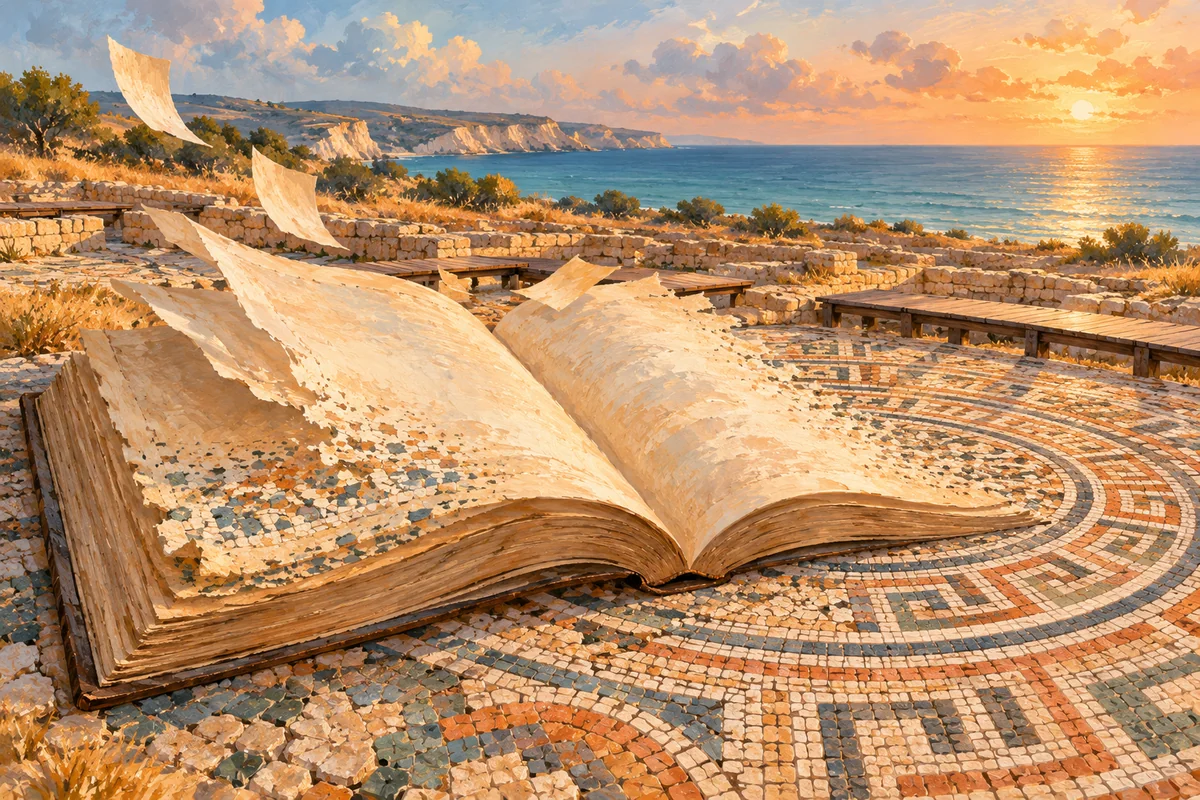
Paphos is a rare city that got its name from a book. In Ovid’s Metamorphoses the sculptor Pygmalion carved a girl from ivory, so beautiful that he fell in love with his own work, and Venus brought the statue to life. They had a child named Paphos and, in the poet’s words, the city took its name from him. In the Odyssey Homer sends Aphrodite “to Cyprus, to Paphos”, to her sanctuary and fragrant altar, and Shakespeare ends the poem Venus and Adonis with the goddess flying off to Paphos to hide from the world.
For more than two thousand years this city has been read, rewritten and retold. The Roman owners of the villas laid their favourite myths on the floors of their halls and labelled the heroes in Greek, so that a guest would recognise them at once. The first Christians went underground to pray, into ancient rock-cut chambers, and left behind traditions that people here still tell. For more than six centuries the theatre on Fabrika Hill gathered thousands of spectators, and on the shore stands a church which, the legend says, God himself hid.
Today you read Paphos as a book. The first chapters are the floors of two Roman houses: the birth of a hero, a fight in the labyrinth, and the procession of a young god. Then come the traditions of the Christian city: the church by the sea, the wishing tree, the underground chapel, the theatre on the hill, and at the end the “saint of lovers”. Legends are offered here as legends, facts as facts, and where they intertwine, we will say so honestly.
What to do: 1) Read the story and the task at each stop. 2) Find the place on the map and walk up to it. 3) Look at the object and answer the question.
The route is on foot, about two kilometres in a straight line (about three on foot), and takes 2–2.5 hours. The first three stops are inside the Kato Paphos Archaeological Park: admission is charged, tickets are sold at the office by the harbour, and the convenient way out is the eastern turnstile onto Apostolou Pavlou Street. The quest “A Capital at the Edge of the Sea” visits other houses in the same park, and the two routes are easy to combine in one day. There is almost no shade in the park — bring a hat and something to drink.
- City: Paphos
- Route: 10 points
- Time: about 2 h 30 min
- Start: Kato Paphos, the ticket office of the Archaeological Park by the harbour
- Format: self-guided, any day, no booking
What is on the route
The route points in order — what these places are and why they are interesting. Tasks and answers stay inside the quest.
The House of Theseus: the hero’s first bath — Archaeological Park, House of Theseus, room 40 — the panel by the sign “The first bath of Achilles”
This is the latest chapter of the stone book of Paphos: the panel in room 40 of the House of Theseus was laid in the 5th century, when the city had long been Christian and the owners of the villa were still ordering pagan myths for the floor. At the centre of the scene is the newborn Achilles.
Opening hours: 16 April – 15 September: daily 08:30–19:30; 16 September – 15 April: daily 08:30–17:00; closed on 25 December, 1 January and Orthodox Easter Sunday · Ticket: 4.50 € (according to Visit Cyprus; worth confirming the price at the ticket office)
Theseus and the Minotaur — House of Theseus, room 36 — a round mosaic medallion under the wooden walkways
The round medallion, more than two metres across, is the very mosaic that gave the villa the name House of Theseus. At the centre the Athenian prince overcomes the Minotaur: with his left hand he has seized the monster by the horn, and the bull-man has already fallen to his knees.
Opening hours: 16 April – 15 September: daily 08:30–19:30; 16 September – 15 April: daily 08:30–17:00; closed on 25 December, 1 January and Orthodox Easter Sunday · Ticket: 4.50 € (according to Visit Cyprus; worth confirming the price at the ticket office)
The House of Aion: procession of a young god — House of Aion — a covered pavilion with the mosaic and viewing walkways, east of the House of Theseus
Under the roof of the pavilion lies a mosaic that is rightly called the most “literary” in Paphos: five panels, and each one a separate myth with Greek captions. It was found in 1983 by the Polish expedition of the University of Warsaw led by Wiktor Daszewski, and the mosaic itself is dated to the middle of the 4th century.
Opening hours: 16 April – 15 September: daily 08:30–19:30; 16 September – 15 April: daily 08:30–17:00; closed on 25 December, 1 January and Orthodox Easter Sunday · Ticket: 4.50 € (according to Visit Cyprus; worth confirming the price at the ticket office)
Panagia Theoskepasti — the church covered by God — Kato Paphos, by the sea east of the harbour, the church of Panagia Theoskepasti
A small domed church of the Mother of God stands right by the sea, and from it you can see the whole eastern part of Kato Paphos. The present building was put up in 1923 on the foundations of a Byzantine church of the 10th century, keeping that church’s architecture, and in 2009 it was fully restored.
A pause: Zorbas bakery (optional) — Apostolou Pavlou Street, the Cypriot bakery Zorbas, a little south of the Agia Solomoni catacomb
Zorbas bakery is a Cypriot chain that everyone on the island knows: bread, pies and sweets are baked and sold here around the clock. The stop stands right on the way to the next chapter, a couple of minutes’ walk from the Agia Solomoni catacomb, so the pause does not take you off the route.
Opening hours: around the clock (according to Google Maps, October 2026)
Agia Solomoni: the wishing tree — Apostolou Pavlou Street, the huge tree above the steps down into the Agia Solomoni catacomb
Above the entrance to the Agia Solomoni catacomb grows a huge old pistachio tree — a terebinth, whose knotted roots go straight down into the ancient masonry. Its lower branches are hung so thickly with what people leave here that from a distance the tree looks mottled, like a festive garland.
The underground chapel of Solomoni — Agia Solomoni catacomb — the courtyard and the chambers below, down the steps from the tree
A narrow stair from the tree leads down into a small open courtyard cut into the body of the hill, and around it five chambers of Hellenistic tombs open out. The largest of them became an underground chapel: an apse is cut into the western wall, and remains of 12th-century paintings survive on the plaster.
The caves of Agios Lambrianos (optional) — The slope of Fabrika Hill, the underground chambers of Agios Lambrianos, 60 m north of Agia Solomoni
A little higher on the slope of Fabrika Hill, two more huge underground chambers of the early Hellenistic period open out. They are linked with the name of Saint Lambrianos, and tradition says that he lived here.
The theatre on Fabrika Hill — Fabrika Hill, the viewpoint above the excavations of the ancient theatre
From the viewpoint you can see the slope of the hill in which the theatre of Nea Paphos was made around 300 BC: the rows of seats are partly cut straight into the body of the hill and partly built up of blocks.
Agios Agapitikos — the saint of lovers — The north-eastern corner of Fabrika Hill, the tiny cave church of Agios Agapitikos
In the north-eastern corner of Fabrika Hill a tiny cave church hides, cut into the limestone, and its niche is packed tight with icons that people bring here.
Where to go next
This route is part of MeTravel city quests. Below are the other quests in this city and cities with quests nearby.