
MeTravel city quest
A quest through Opole: carols in the capital of song
Opole: a free walking route “A quest through Opole: carols in the capital of song” past the sights. Self-guided, any day, no booking. 9 points.
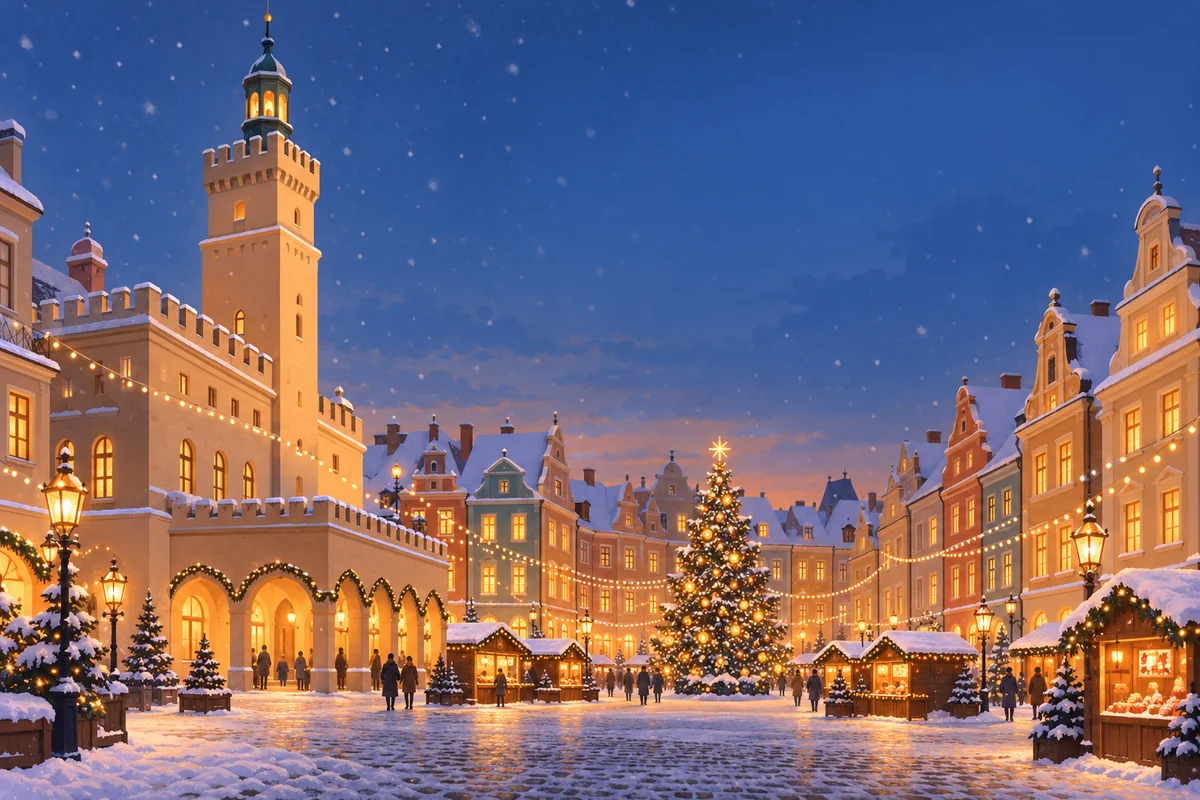
Opole is called the capital of Polish song: since the summer of 1963 the National Festival of Polish Song has been held here, bronze stars are set into the pavement by the town hall, and bronze singers and poets stand around the city. But Polish song has a genre far older than any festival — carols and pastorałki, Christmas songs that in Silesia were sung from house to house long before radio and television. In Opole Silesia, gifts on Christmas Eve are brought not by Santa but by Dzieciątko — the Infant Jesus — and in the old houses a betlejka, a home nativity, mattered more than the tree; it was beside it that they sang the carols.
Today you will walk Opole as a winter concert in nine numbers: from the rock star by the railway station — to the philharmonic named in honour of Chopin's teacher, to the “Black Angel” of Polish song by the amphitheatre, across the Market Square with its Christmas market — to the museum of Silesian customs, to the baroque lady named Winter, to the saint who carries the Infant on his shoulder, to the square of the poet-songwriters and, finally, to the theatre that grew out of a Christmas nativity play. About two kilometres on foot, with no doubling back; on the Market Square, halfway along, a café for a break.
Best of all from December to mid-January, when the lights are on; the tasks work all year round: every answer is on bronze, stone, and facades, and the market and the garlands only decorate the story.
We start at the Main Railway Station, on Kora Square, opposite the Main Post Office.
- City: Opole
- Route: 9 points
- Time: about 2 h
- Start: Opole, Kora Square (Plac Kory) by the Main Railway Station
- Format: self-guided, any day, no booking
What is on the route
The route points in order — what these places are and why they are interesting. Tasks and answers stay inside the quest.
Kora — the voice the route begins with — Kora Square, opposite the Main Post Office
The bronze Kora stands on the square that bears her name, in a stage pose, microphone in hand — the way she is remembered from concerts. The monument by the Opole sculptor Marian Molenda was unveiled in June 2026, during the 63rd festival, opposite the Main Post Office, on the square that has borne the singer's name since 2023.
The Elsner Philharmonic — a lullaby in the scherzo — Opole Philharmonic, the glass rotunda on the Freedom Square side
The glass rotunda of the Opole Philharmonic faces Freedom Square (Plac Wolności), and on the lawn in front of it three bronze musicians are playing — a young man and two young women.
The Black Angel by Castle Pond — Castle Pond by the Millennium Amphitheatre, the bronze Ewa Demarczyk
By Castle Pond, a couple of steps from the Millennium Amphitheatre, stands the bronze Ewa Demarczyk in a long concert gown — life-size, her gaze lifted to the sky. Marian Molenda's statue was unveiled in June 2025, and it began a new route of monuments to the festival's musicians in the city.
Opening hours: Museum of Polish Song in the amphitheatre building: Tue–Sun 10:00–18:00, Mon closed (check the website)
A break on the Market Square: “Pyszne Historie” (optional) — Café “Pyszne Historie”, Market Square, 13
The café “Pyszne Historie” — “Tasty Stories” — occupies house number 13 on the north-western side of the Market Square, opposite the town hall. They serve breakfast, coffee, and homemade cakes, and on Google Maps the café has a rating of 4.7 from nearly 1800 reviews — one of the Old Town's best-loved addresses.
The Museum of Opole Silesia — who brings the gifts — Mały Rynek 7, the main entrance of the Museum of Opole Silesia
The long building with red window surrounds on the Mały Rynek is the former Jesuit college, counted among the oldest buildings in the city.
Opening hours: Tue–Sun, Monday closed; exact hours are on the museum website · Ticket: regular 15–25 zł, reduced 10–15 zł (2025–2026 rates, check at the ticket desk)
Baroque Winter on University Hill — The “Four Seasons” avenue by Collegium Maius, Muzealna Street
Along the avenue by Collegium Maius stand four stone ladies: Spring with garlands of flowers, Summer with a sheaf, Autumn with a bunch of grapes, and Winter — an old woman in a fur-lined coat, her hands tucked into a muff.
Saint Krzysztof and the Infant — The neo-Gothic aedicula of Saint Krzysztof by Collegium Maius, Copernicus Square
Under a pointed neo-Gothic canopy on slender columns stands a stone giant — Saint Krzysztof — and the Infant Jesus sits on his shoulder. This aedicula was brought here from the park of the Schaffgotsch palace in Kopice, where the figure stood on a stone footbridge over the canal between the ponds.
Artists' Square: two Older Gentlemen — Artists' Square on the eastern slope of University Hill, the Older Gentlemen's bench
On the eastern slope of University Hill lies Artists' Square — a gallery of bronze poets, composers, and people of the theatre, linked to Opole and the festival.
The theatre that grew out of a nativity play — Opole Puppet and Actor Theatre, Kośnego Street, 2a
The glass facade on Kośnego Street is the Opole Puppet and Actor Theatre named after Alojzy Smolka, one of the oldest puppet theatres in Poland.
Where to go next
This route is part of MeTravel city quests. Below are the other quests in this city and cities with quests nearby.