
MeTravel city quest
Opole: Ofka's ring and midnight over the Oder
Opole: a free walking route “Ofka's ring and midnight over the Oder” past the sights. Self-guided, any day, no booking. 10 points. Approximately 1 h 40 min.
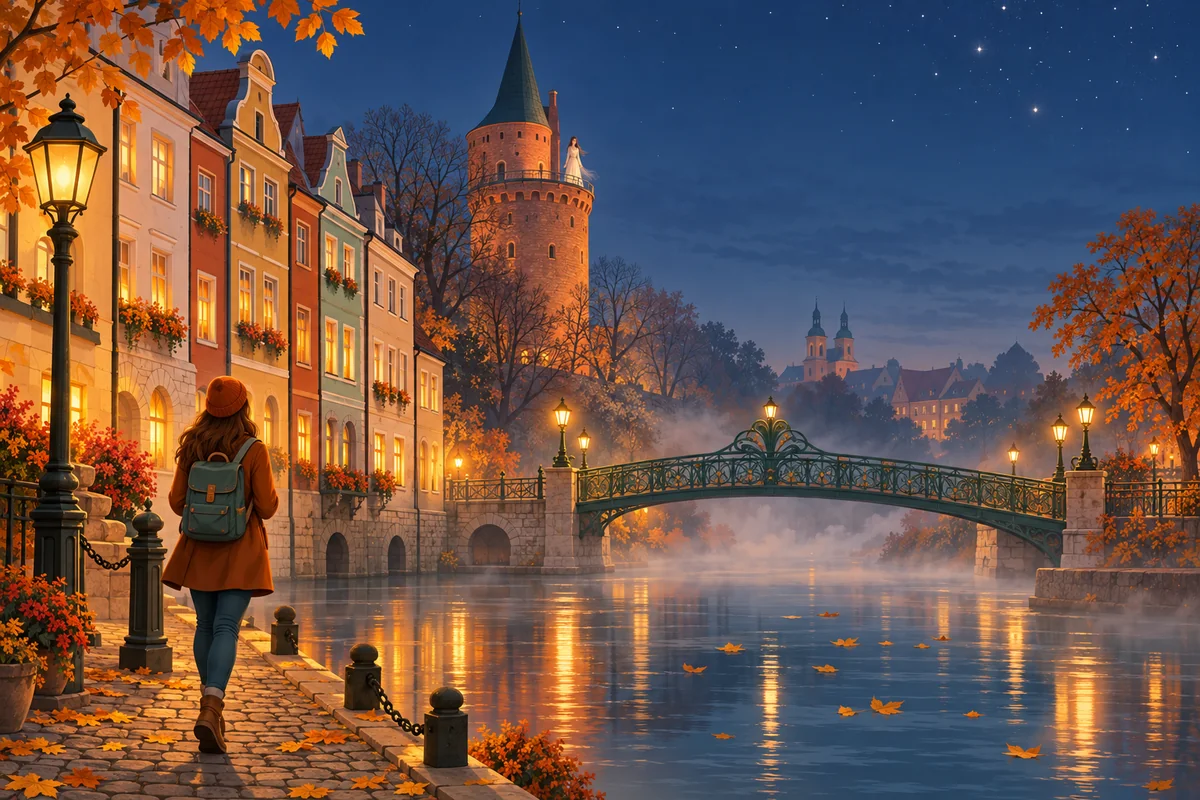
Opole is a city on the Oder where every old street has a tenant for the night. People here still say that at midnight a thin chime rings out over Pasieka Island: it is Princess Ofka's ring striking the stones.
The legend goes like this. The proud beauty Ofka turned away every suitor until Prince Jan the Good, of the Opole Piasts, won her heart. The wedding was set for just after Kupala Night, but at the top of the castle tower Ofka suddenly broke off the engagement and threw the wedding ring down. The insulted prince ordered her walled up in the dungeon of the tower, and he himself never looked at another woman again. Since then, they say, the White Lady appears on the tower and, on the last stroke of midnight, drops the ring once more — and whoever finds it will be happy, rich, and healthy.
This tale has a documentary shadow: Jan II the Good, the last prince of the Opole branch of the Piasts, really never did marry, and died childless in 1532. And today the city leads an official trail through its legends, from the Piast Tower to the Upper Castle.
Your route is a search for the ring. You will walk the Old Town from the cathedral to the Market Square, go down to the Młynówka canal and Pasieka Island, and along the way listen to Opole's other tenants of the night: the cursed traveller at the city gate, the prince's boar, the water spirit and his daughters. It is about a kilometre and a half, with no doubling back, and halfway along there is a café on the Market Square. Best of all at dusk, when the lanterns come on: every stop stands on a lit street or square.
We start at the cathedral on Katedralna Street — Jan the Good himself rests there.
- City: Opole
- Route: 10 points
- Time: about 1 h 40 min
- Start: Opole, the Old Town and Pasieka Island
- Format: self-guided, any day, no booking
What is on the route
The route points in order — what these places are and why they are interesting. Tasks and answers stay inside the quest.
The cathedral where Ofka's fiancé rests — Opole Cathedral, the main entrance from Katedralna Street
Before you is Opole Cathedral — a Gothic brick church with two tall neo-Gothic towers that can be seen from every bridge over the Oder. The main entrance has bronze doors, covered all over with reliefs: on them the history of the city and the church is told face by face, from the patron saints to the princes and bishops.
The church that grew on the site of a tavern — Saint Sebastian's Square, the facade of the little church
The small, light church of Saint Sebastian stands on a tiny square, squeezed between houses: a narrow facade under a sharp gable, a round window, and a little lantern-turret on the ridge of the roof.
The Upper Castle: the prince's boar and the black dog at the gate — Upper Castle (Zamek Górny), the small park with the bronze prince in front of the tower
Before you is the Upper Castle — a massive Gothic residential tower of red brick, with battlements along the top, and in front of it, on a granite pedestal, stands the bronze prince Władysław II Opolczyk, wearing a crown.
Opening hours: Mon, Wed–Fri 9:00–17:00; Sat–Sun 10:00–18:00; Tuesday closed (city hours for 2026 — check before you visit)
Saint Wojciech's Hill — University Hill, the stone with the footprints by the church “Na Górce”
You have climbed University Hill — the highest place in the Old Town. Nearby is the main building of the University of Opole, and bronze poets and musicians stand all around.
A break under the arcades (optional) — Café “Pod Arkadami”, the corner of the Market Square and Krakowska Street
From the hill, Świętego Wojciecha Street drops straight down to the Market Square, past old stone houses that now hold galleries of the Museum of Opole Silesia.
Opening hours: usually opens at 10:00; check the closing time on the spot
The Market Square: midnight for the water spirit's daughters — Market Square, the equestrian monument by the south wall of the town hall
Opole's Market Square is a rectangle of colourful baroque and classicist stone houses, and in the middle stands the town hall, with a tall tower built on the model of Florence's Palazzo Vecchio.
The Franciscans: the house of the stone Piasts — Holy Trinity Church (the Franciscans), Freedom Square (Plac Wolności)
Beyond the Market Square, on Freedom Square, stands the Gothic Church of the Holy Trinity — the Franciscan church, built in the 14th century. Outside it is stern and brick, and almost without ornament, and inside it keeps what historians come here for: the chapel of Saint Anne, which in Opole they call the Piast Chapel.
Castle Bridge: the water spirit and Papa Musioł — Castle Bridge (Most Zamkowy) over the Młynówka, the bronze passer-by by the bridge
The Castle Bridge spans the Młynówka — an old arm of the Oder that separates the Old Town from Pasieka Island. On both sides, colourful houses step down to the water, set on the foundations of the medieval city walls, and in Opole they fondly call this panorama “Opole's Venice”.
The Piast Tower: the White Lady's balcony — Piast Tower (Wieża Piastowska), Piastowska Street, Pasieka Island
Beyond the bridge, on Pasieka Island, a round brick tower rises, with a tall pointed spire and a wrought-iron weather vane turning at the very top. This is the Piast Tower, one of the oldest defensive towers in Poland, and the only thing left of the princely castle of the Opole Piasts.
Opening hours: Mon–Wed, Fri 9:00–17:00; Sat–Sun 10:00–18:00; Thursday closed (city hours for 2026 — check before you visit); the viewing platform only with a tour guide, about 30 minutes · Ticket: according to the city price list; concessions for children over 3, schoolchildren and pensioners; children under 3 free
The Lovers' Bridge: where midnight ends — Groszowy Bridge over the Młynówka, the portal on the Mozarta Street side
An openwork steel footbridge in the Art Nouveau style, with lanterns on tall portals and stone supports, links Pasieka Island to the Old Town. A footbridge has stood on this spot since 1894, and the present one, of two spans, was built in 1903 — a plaque by the entrance tells you so.
Where to go next
This route is part of MeTravel city quests. Below are the other quests in this city and cities with quests nearby.