
MeTravel city quest
An Alanya quest: the Red Tower and the city that changed its names
Alanya: a free walking route “An Alanya quest: the Red Tower and the city that changed its names” past the sights. Self-guided, any day, no booking. 9 points.
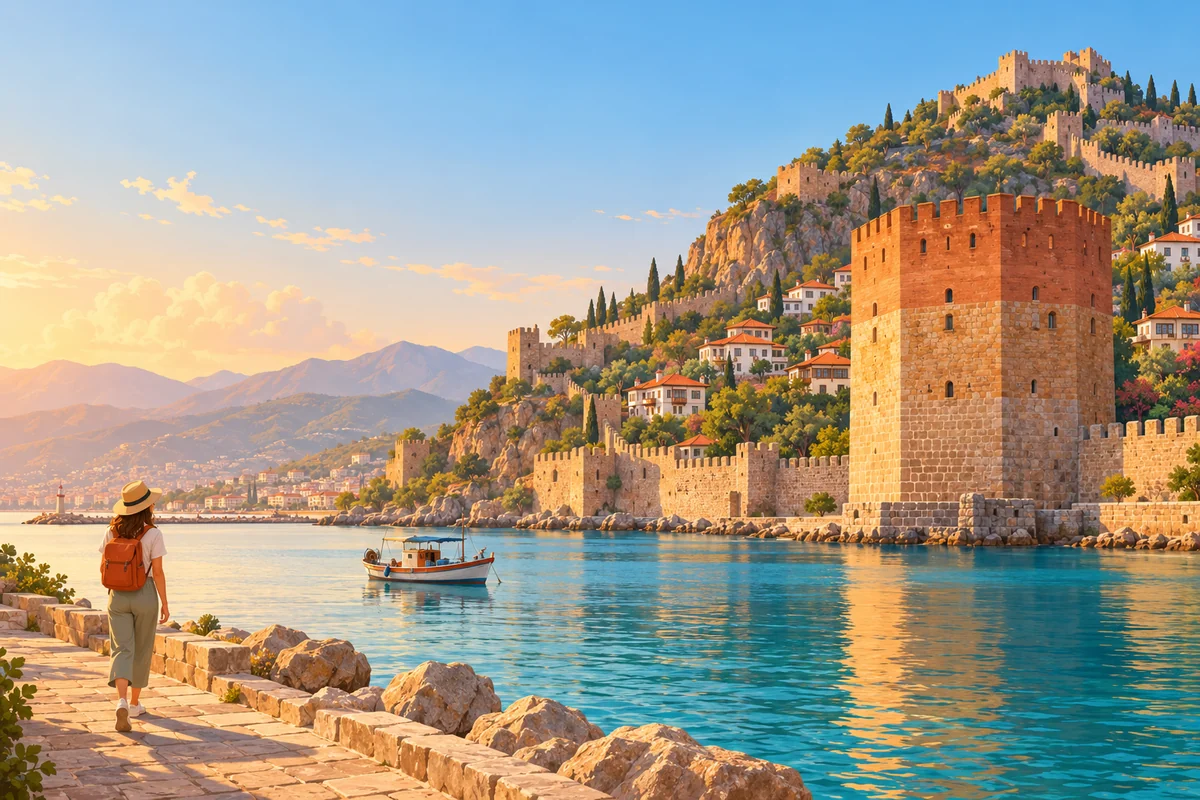
This city had four names, and each one came from new masters. Greek geographers of the 4th century BCE called it Coracesium. The Byzantines called the rock above the sea Kalonoros — “beautiful mountain”: it can be seen from a deck far off, and sailors took their course by it. In 1221 the fortress passed to the Seljuk sultan Ala ad-Din Kayqubad I, and the city became Alaiye — in honour of the sultan himself. Its present name, Alanya, came later, in the Turkish Republic, after Atatürk came here in 1935.
How the sultan got the unassailable rock is told in different ways. The chronicles speak of a siege that lasted about two months, and of the fortress being surrendered by its owner, Kir Fard. Legends add two stories. In one, Kir Fard’s daughter became the sultan’s wife, and the city supposedly passed to him almost as a dowry. In the other, the sultan took the fortress by a trick you will hear about by the walls, nearer the end of the route.
Today you will walk this city from the oldest name to the newest: from the museum where the coins of Coracesium are kept, through a cave found by a blast, to the harbour where Atatürk came ashore, and on to the eight-sided tower and the sultan’s shipyard.
What to do: 1) Read the story and the task at each stop. 2) Find the place on the map. 3) Look around and answer the question.
The route is on foot, about two kilometres along a level embankment; only by the tower do you climb a stone lane. The cable car to the top is not part of the route. Bring water and a snack: in winter some of the cafés by the sea are closed, and in the heat there is little shade on the embankment. We start at the museum on the western shore of the isthmus.
- City: Alanya
- Route: 9 points
- Time: about 2 h 30 min
- Start: Alanya, the peninsula with the fortress
- Format: self-guided, any day, no booking
What is on the route
The route points in order — what these places are and why they are interesting. Tasks and answers stay inside the quest.
The museum that keeps Coracesium — Alanya Museum (Alanya Müzesi), the gate from İsmet Hilmi Balcı Street
The Alanya Museum occupies a light two-storey building with columns at the entrance and a large inscription, MÜZE, above the windows of the second floor. Behind the fence is a garden where Roman sarcophagi, gravestones, and an olive press stand under shelters.
Opening hours: daily; from 2 October to 30 April 08:30–17:30, longer in summer · Ticket: foreign visitors 4 € (paid in lira at the exchange rate; from 1 April 2027 — 5 €), Turkish citizens 200 TRY, free with MüzeKart, free for children under 8
The cave a blast found — Damlataş Cave (Damlataş Mağarası), the entrance by the beach
The entrance to Damlataş Cave hides at the foot of the fortress rock, right by the city beach, behind the ticket desk and the souvenir shops. The name means “dripping stone”: drops still seep from the cave ceiling, and over thousands of years stalactites and stalagmites have grown from them.
Opening hours: daily; for visitors from 10:00 (the early morning is given over to treatment sessions); check the evening closing time at the desk · Ticket: about 150 TRY (2026); a combined ticket “cave + Kızıl Kule tower + shipyard” about 225 TRY; municipal rate, card payment
The harbour of the “beautiful mountain” — The pedestrian embankment of the harbour north of the tower, by the pier for excursion boats
Alanya’s harbour lies on the eastern side of the peninsula, under the fortress rock, and is closed off from the sea by a long stone breakwater with a white lighthouse at the end. Wooden excursion boats stand at the pier along the embankment, and above them rises the rock, with walls zigzagging up it.
The man who stepped off a ship — The terrace at the foot of the tower on the harbour side, the bronze monument to Atatürk
The bronze Atatürk stands full length at the foot of the tower, on the terrace facing the harbour, and looks across the harbour at the city. He is in a formal three-piece suit, one hand raised to his chest, as if he had stopped in the middle of a conversation.
Arches at the edge of the bay — The lookout by the sea south of the tower, with a large anchor in the middle
From the terrace by the sea, where a large iron anchor lies in the middle, the whole small bay under the walls opens up. At its far end, right by the water, you can see a long low building with arches, and beside it a square tower.
The sultan’s tower — The entrance to Kızıl Kule from the path Tersane Çıkmazı, the boards on the rock by the entrance
Kızıl Kule rises 33 metres above the harbour: the lower part is built of dressed stone, the upper part of brick, and along the edge run crenellations and projecting machicolations. In plan it is eight-sided, about 29 metres across, and inside it has five levels, the upper three of them open terraces.
Opening hours: daily; from April to October about 09:00–19:00, in winter about 08:00–17:00 — check at the desk · Ticket: according to 2025 reviews, 100–180 TRY for the tower; a combined ticket “tower + shipyard + Damlataş cave” about 225 TRY; municipal rate, card payment
A pause above the bay (optional) — Tersane Cafe, Tersane Çıkmazı Sokak 7, the Tophane quarter
Tersane Cafe stands on a stone lane in the Tophane quarter, on a terrace right above the bay and the shipyard. They serve a Turkish breakfast, menemen, gözleme, and freshly squeezed juices, and from the terrace you can see both the tower and the arches of Tersane.
Opening hours: daily 07:30–18:00 (according to Google Maps; hours may be shorter in winter)
Machines for a siege — The wooden walkway along the fortress wall on the way to the shipyard, the siege machines
A wooden walkway runs along the fortress wall from the tower to the shipyard, and full-size siege machines stand on it — copies of medieval ones, each with a plaque in Turkish and English. Frames of dark timber, wheels, ropes, and long levers show how fortresses were taken in the 13th century.
The shipyard of the sultan of the two seas — The entrance to the Tersane shipyard, the end of the walkway along the wall
The walkway brings you to the entrance of Tersane, a stone shipyard whose vaulted bays run straight into the sea. Above the entrance a five-line inscription is set into the wall, with the sultan’s coat of arms and carved rosettes, praising Kayqubad I, and to the right of the entrance there was a small mosque for the craftsmen.
Opening hours: daily; from April to October about 09:00–19:00, shorter in winter — check at the desk · Ticket: according to 2025 reviews, 100–150 TRY; a combined ticket “tower + shipyard + Damlataş cave” about 225 TRY; municipal rate, card payment
Where to go next
This route is part of MeTravel city quests. Below are the other quests in this city and cities with quests nearby.