
MeTravel city quest
A Wrocław Quest: The Lamplighter and the Lights of Tumski Island
Wrocław: a free walking route “A Wrocław Quest: The Lamplighter and the Lights of Tumski Island” past the sights. Self-guided, any day, no booking. 10 points.
In December Wrocław smells of gingerbread and mulled wine: a Christmas fair, one of the largest in Poland, bustles on the Market Square. Its pedigree is long. As early as 1566, here in what was then German Breslau, the first stalls of the Kindelmarkt — the “children’s market” — went up. Later it opened on 13 December, on St Lucy’s Day, and traded until Epiphany, and the symbol of the fair was gingerbread hearts with inscriptions in icing. At the beginning of the 20th century the Kindelmarkt disappeared, and only in 2008 did the fair return to the Market Square — to three sides of the square, to ul. Świdnicka, ul. Oławska and plac Solny.
But this quest is not about the fair. It is about what the Wrocław holidays were made of. After 1945 people came to the emptied city from Lviv and Vilnius, from Greater Poland, Mazovia and Lesser Poland. Each family brought its own Christmas Eve: in some houses the gifts were brought by the Dzieciątko, as the custom was in Silesia, in others by the Gwiazdor or the Aniołek; on some tables there was kutia, on others carp and makowiec. From these foreign Christmas Eves the city, over eighty years, gathered one of its own.
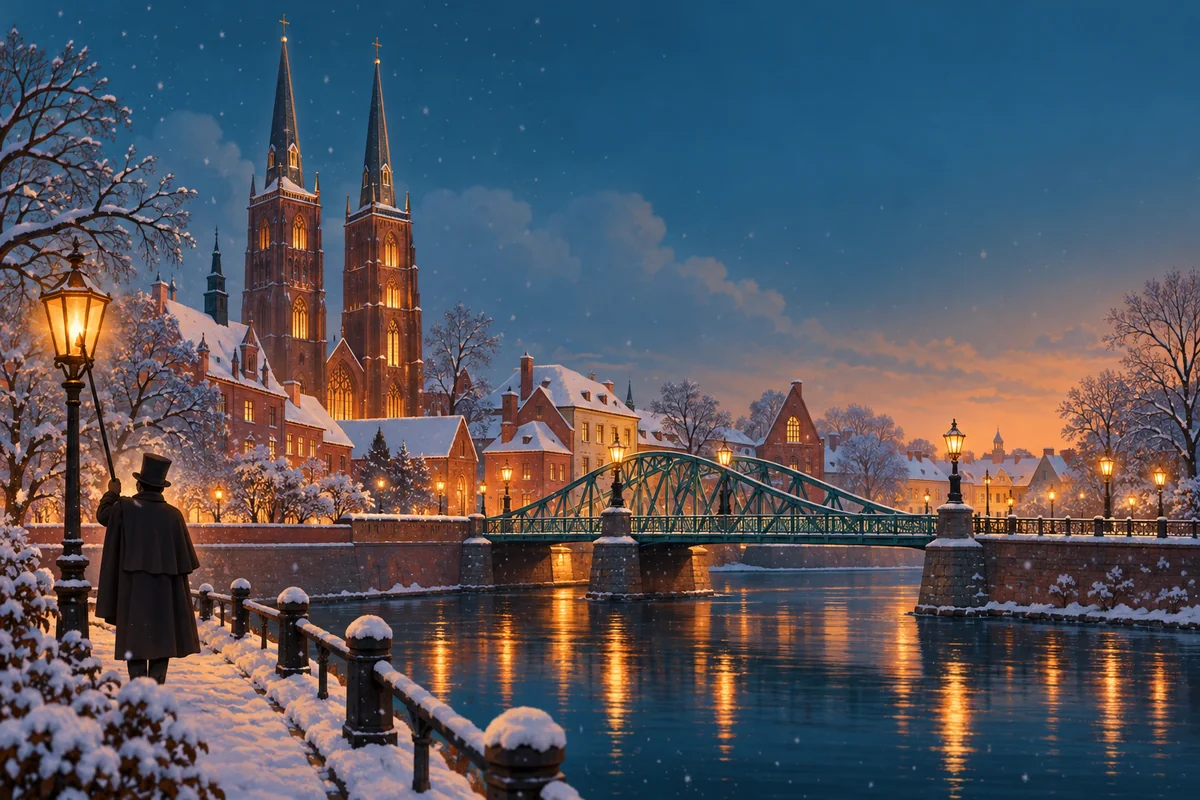
The route leads from the Ossolineum through Hala Targowa and Piasek Island to Tumski Island, where the gas lanterns are still lit by hand. About a kilometre and a half on foot, with no doubling back, and halfway along there is a café for a rest. It is best to go from December to the middle of January, when the lights are burning, and to reach Tumski Island at dusk, around half past three; the tasks work all year round. The churches on the route are active, so every task is done outside.
From the Market Square, walk north along ul. Szewska, almost to the Odra itself — to the gates of the Ossolineum.
- City: Wrocław
- Route: 10 points
- Time: about 1 h 30 min
- Start: Wrocław, the Old Town and the islands on the Odra
- Format: self-guided, any day, no booking
What is on the route
The route points in order — what these places are and why they are interesting. Tasks and answers stay inside the quest.
The Ossolineum — Lviv That Moved to the Odra — Zakład Narodowy im. Ossolińskich, ul. Szewska 37
In front of you is the long baroque wing of the former monastery of the Knights of the Cross with the Red Star — a hospitaller order that came to Wrocław as early as the 13th century.
Hala Targowa — the Market Women at the Entrance — Hala Targowa, the main entrance from ul. Piaskowa
In front of you is Hala Targowa — a red-brick covered market with two little towers, built in 1906–1908 to a design by the city architect Richard Plüddemann and Heinrich Küster. From the outside it looks like a fortress, and inside it rests on huge reinforced-concrete arches — a bold structure for the beginning of the 20th century.
The Library on Piasek — Home of a Children’s Song — The former Augustinian monastery, ul. Świętej Jadwigi 3/4
Once you have crossed Piaskowy Bridge, you are on Piasek Island, and to the right stretches a long baroque facade with pink cartouches — the former monastery of the Augustinian canons. Above the main portal stand three sculptures: Mary in the centre and two angels at the sides, each holding a gilded sign.
The Church Where Christmas Eve Comes on 6 January — The Orthodox church on ul. Świętej Jadwigi, across the street from the library
The yellow baroque facade across the road from the library is the former church of St Anne, built in 1686–1690 on the site of a medieval chapel. Behind the ornate facade, the brick single-nave church hides a quite different world: inside there is an iconostasis and walls painted for the Eastern liturgy.
Baldachim Café — a Rest on Piasek (optional) — Baldachim kawiarnia, ul. Świętej Jadwigi 9/1A
Half the route is behind you, and a few steps north along ul. Świętej Jadwigi a tiny café, Baldachim, is tucked away — a couple of tables, a display of cakes and a warm light in the window.
Opening hours: Mon 11:00–20:00, Tue–Sun 10:00–20:00 (per Google Maps, October 2026)
The Cardinal by the Church on Piasek — The monument to Cardinal Bolesław Kominek by the Church of Our Lady on the Sand
The tall bronze figure in front of the Gothic Church of Our Lady on the Sand is Cardinal Bolesław Kominek, the first Polish metropolitan of Wrocław. The sculptor Sławoj Ostrowski drew the silhouette upward, repeating the lines of the pointed windows of the church behind the cardinal, and modelled only the face and the hands realistically.
Tumski Bridge — the Lamplighter’s Road — Tumski Bridge (Most Tumski), between Piasek and Tumski Island
In front of you is Tumski Bridge — a short steel bridge over an arm of the Odra, leading into the oldest part of the city. At the entrance from the Piasek side stand stone figures of St Hedwig and St John the Baptist, and the railings are hung with lovers’ locks.
St John of Nepomuk and the Bald Little Angels — The square in front of the Church of the Holy Cross (plac Kościelny)
In front of the two-level Gothic Church of the Holy Cross a baroque column rises, about nine and a half metres tall — a monument to St John of Nepomuk, patron of bridges and of those who can keep a secret.
The Madonna in front of the Cathedral — plac Katedralny, in front of the main entrance to the cathedral of St John the Baptist
In front of the main portal of the cathedral, behind a stone balustrade, stands a sandstone statue of Mary with the Child in her arms. It was set up in 1694, and it is the oldest surviving monument in Wrocław; the maker’s name has not survived, and the statue is most often attributed to the Netherlandish sculptor Sulpicius Gode.
The Gate Where a Treat Turned to Stone — The arch between the church of St Giles and the chapter house, plac Katedralny
A brick arch under a tiled roof joins the church of St Giles — the oldest surviving building in Wrocław — to the chapter house of the 16th century. It is called Brama Kluskowa, that is, the Kluska Gate, and kluski are Silesian potato dumplings with a dimple in the middle.
Where to go next
This route is part of MeTravel city quests. Below are the other quests in this city and cities with quests nearby.
Quests in nearby cities
- Собутка
— 1 quest, 35 km
- Ополе
— 2 quests, 79 km
- Карпач
— 1 quest, 97 km
- Шклярска-Поремба
— 1 quest, 111 km
Travels: Wrocław
Traveller articles about this city will help round out the walk.