
MeTravel city quest
Warsaw: The White Lady and the Tales of the New Town
Warsaw: a free walking route “The White Lady and the Tales of the New Town” past the sights. Self-guided, any day, no booking. 10 points.
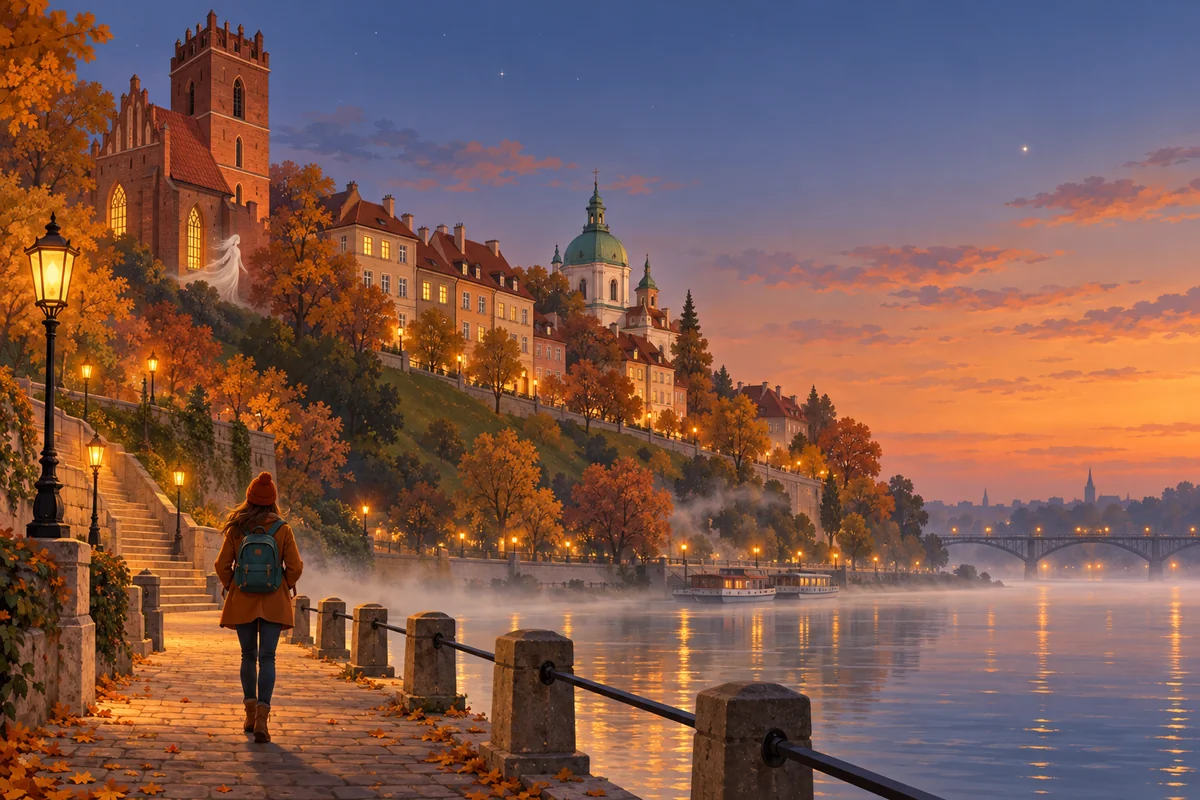
In Warsaw there is a tale that the poet Artur Oppman set down in verse in the book “Warsaw Legends” (the 1925 edition). In the Royal Castle, it says, lives the White Lady. She first appears to King Stanisław August in the autumn of 1794, on the night when the cannon fire on Praga: dressed all in white, with a scarlet wound on her breast, she looks at the weak king with reproach and whispers that the country is drowning in blood. The Lady shows herself a second time in 1920, when the army returns to the capital in victory: she stands in a window of the castle and blesses the regiments. The Lady comes in times of disaster and in times of rebirth. This is not an old folk belief, but a poetic legend, and it should be told honestly — as a poet’s tale.
Oppman was born in Warsaw in 1867. All his life he wandered the Old Town and collected the city’s traditions. He opens the book with a scene by the stove: a winter evening, a blizzard knocking at the windows, the grandchildren asking their grandfather to tell them “about Warsaw” — and the grandfather recalls the mermaid’s song over the Vistula, the basilisk’s cellar, and the Lady weeping in the castle.
Today you will walk the northern edge of the Old Town and, through the Barbakan, into the New Town, once a separate town, New Warsaw. There are fewer tourists here, and more shadows: the execution ground by the city wall, the vow of the plague year, the monk who carried a sacred object out of burning Kyiv, test tubes glowing in the dark, stone guardians with a talisman, robbers with a candle of dead man’s fat, and snow that fell in July. Some pages are legends, others are documented history; which is which will be said plainly.
The route is about a kilometre, ten stops, an hour and a half at an easy pace, and halfway along you can warm up with hot chocolate. It is best to go at dusk, when the lamps are lit: every stop stands on a lit street or square. Enter the churches quietly, and during a service look only from the doorway.
The start is at the monument to Jan Kiliński on Podwale Street, where Piekarska Street comes out to the city walls.
- City: Warsaw
- Route: 10 points
- Time: about 1 h 30 min
- Start: Warsaw, the Old Town and the New Town
- Format: self-guided, any day, no booking
What is on the route
The route points in order — what these places are and why they are interesting. Tasks and answers stay inside the quest.
The Shoemaker at Piekiełko — Monument to Jan Kiliński, corner of Podwale and Piekarska Streets
The bronze man in a long kaftan, lunging forward with his right arm raised, is Jan Kiliński, a Warsaw shoemaker. The monument, by Stanisław Jackowski, stands on a tall granite pedestal by the old city walls, where Piekarska Street comes out onto Podwale.
The Vow of the Plague Year — Holy Spirit Church (the Paulines), corner of Długa and Freta Streets
Just past the Barbakan, on the corner of Długa and Freta, stands the pale baroque church of the Holy Spirit; at its main entrance, between two old lanterns, a statue of the Virgin Mary rises on a carved pedestal.
The Monk from Burning Kyiv — St Hyacinth’s Church (św. Jacka), Freta Street 8/10
A little farther along Freta, on your right, runs the austere pale facade of St Hyacinth’s Church, and beside it stand a separate bell tower and the Dominican monastery. The Dominicans bought this plot in 1603, first put up a wooden chapel, and had the stone church finished by 1639.
The House of the Glowing Test Tubes — Freta Street, 16 — the house with a plaque on the facade
Across the street and a little farther on, a stone plaque with letters cut into it hangs on the white facade of house number 16 on Freta. In this house, on 7 November 1867, Maria Skłodowska was born, the future Marie Curie, twice a Nobel laureate; today her museum occupies the townhouse rebuilt after the war.
Opening hours: Tue–Fri 12:00–18:00, Sat–Sun 11:00–18:00, Mon closed; last entry 30 minutes before closing; closed on 1 November · Ticket: 17 PLN, reduced 10 PLN; on Tuesdays entry is free for individual visitors
Hot Chocolate at Wedel (optional) — Pijalnia Czekolady E. Wedel, Freta Street 13/15
Opposite the Curie house, at Freta 13/15, the windows of the E. Wedel chocolate parlour, Pijalnia Czekolady, are lit. This is an old Warsaw chocolate brand, and what they drink here is thick hot chocolate, not cocoa from a packet.
Opening hours: Mon–Sat 11:00–22:00, Sun 10:00–22:00
The Coat of Arms of New Warsaw — New Town Market Square, a cast-iron pump in the southern part of the square
Freta brings you out onto a spacious, slightly sloping square — the New Town Market Square — and in its southern part stands a dark cast-iron water pump with twisted bars along its sides.
Stone Guardians with Shields — Stone bears by the benches on the southern edge of the New Town Market Square
Along the southern edge of the square runs a low stone wall with benches, and at its ends two pale stone bears sit up on their hind paws. Each presses a shield to its chest, and carved on the shield is a human face framed by strange writhing locks.
The Queen’s Vow and the Stone Skull — St Casimir’s Church (the Sacramentines), New Town Market Square 2
On the east side of the square stands a snow-white church under a green dome — St Casimir’s Church, at the convent of the Sacramentine sisters. Its facade, with a triangular pediment and a carved heraldic cartouche, looks straight onto the market, and the dome on its high drum is visible from far away.
Snow in July — Church of the Visitation of the Virgin Mary, Przyrynek Street 2
The little street Przyrynek leads out to the oldest church of the New Town — the Gothic church of the Visitation of the Virgin Mary, in red brick, with a massive square bell tower. In front of it, behind a wrought-iron fence, between two old lanterns, a white statue of the Virgin Mary stands on a tall pedestal.
Above the Vistula — Monument to Maria Skłodowska-Curie at the edge of the escarpment, the end of Kościelna Street
At the edge of the escarpment, where Kościelna Street breaks off above the Vistula, stands a bronze Maria Skłodowska-Curie. The slender figure faces the Vistula and holds in her raised hand an openwork cube with rings of orbits — a model of the atom of the element she named in honour of Poland.
Where to go next
This route is part of MeTravel city quests. Below are the other quests in this city and cities with quests nearby.
Quests in nearby cities
- Лодзь
— 3 quests, 119 km
- Казимеж-Дольны
— 1 quest, 122 km
- Ленчица
— 1 quest, 125 km
- Люблин
— 3 quests, 155 km
Travels: Warsaw
Traveller articles about this city will help round out the walk.