
MeTravel city quest
A quest through Szczecin: two winters of one city
Szczecin: a free walking route “A quest through Szczecin: two winters of one city” past the sights. Self-guided, any day, no booking. 9 points.
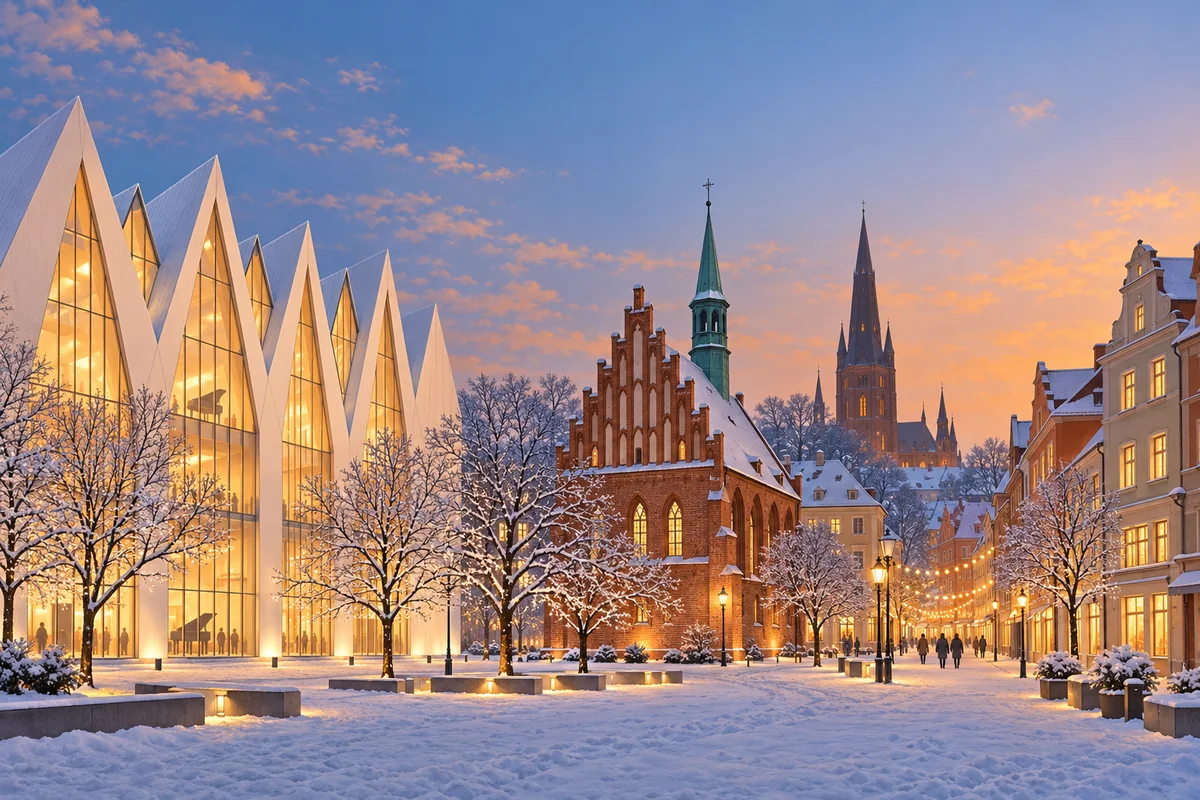
Szczecin greets December twice — at least, that is how it seems if you walk through it slowly. Until 1945 this was German Stettin, a Protestant port city of Prussian gates, baroque palaces and Christmas trees in the windows. After the war Polish families moved here from all over the country and from the former eastern lands, and each brought its own Christmas Eve: for some, gifts are brought by Gwiazdor in a sheepskin coat with the fur side out; for others, kutia stands on the Christmas Eve table.
This route is about both winters at once. You will meet a professor who never parts with the road, a poet who moved from Lviv together with the townspeople, the gate through which Prussia entered the city, the house where a girl from Stettin was called to Russia on New Year's Day, and the place where the city's first church was built nine centuries ago. Midway there is a warm rest stop with a Szczecin pasztecik.
The route is on foot, about a kilometre and a half and nine stops, with no doubling back. The best time is from December to the middle of January, when the lights are on; the tasks work all year. At the churches every task is done outside: services may be going on inside.
We start in Anders Square, by the bronze bench-monument on the avenue.
- City: Szczecin
- Route: 9 points
- Time: about 1 h 30 min
- Start: Szczecin, the city centre
- Format: self-guided, any day, no booking
What is on the route
The route points in order — what these places are and why they are interesting. Tasks and answers stay inside the quest.
The professor who is always on the road — Anders Square («skwer Andersa»), the bench-monument to the professor («Pomnik Jana Czekanowskiego»)
In front of you is a black-and-gold bench-monument: a professor in the travelling suit of a European explorer of Africa from the late 19th century sits with one leg crossed over the other, and a place beside him is left for a passer-by.
A poet who came from Lviv — Victory Square («plac Zwycięstwa»), a garden with a bronze bust («Pomnik Kornela Ujejskiego»)
In front of you is a bronze bust of a man with a full moustache and a laurel branch at his chest, on a tall granite pedestal — the Polish poet Kornel Ujejski, author of the chorale «Z dymem pożarów» (With the smoke of the fires).
The gate through which Prussia came in — The Port Gate («Brama Portowa»), on the square of the same name
In front of you is a stone baroque gate with a crown, a coat of arms and military trophies above the arch — the Port Gate, called the Brandenburg Gate on the Latin inscription. It was built in 1725–1727 to a design by the Dutch fortification engineer Gerhard Cornelius van Walrave, and the sculpture was done by Bartolome Damar.
A rest stop: pasztecik with borscht (optional) — «Pasztecik», ul. Wyszyńskiego 10
A few steps from the gate, on the way to the cathedral, is a little bar, «Pasztecik», where they fry Szczecin's main street food. Pasztecik szczeciński is an oblong pastry of yeast dough, deep-fried, with meat, with cabbage and mushrooms, or with cheese.
Opening hours: Mon–Fri 10:00–18:00, Sat 10:00–16:00, Sunday closed
The cathedral and the five truths — Archcathedral of St James, the plaques on the wall by the west tower («Prawdy Polaków spod znaku Rodła», Truths of the Poles under the Rodło sign)
In front of you is the huge brick hall of the Archcathedral of St James, with a tower that got its spire back already in the 21st century — it rises again to about 110 m. The townspeople founded the church in 1187, taking St Mary's Church in Lübeck as their model.
The palace where an empress was born — White Eagle Square («plac Orła Białego»), the baroque palace on the west side («Akademia Sztuki», Academy of Art)
In front of you is a baroque palace with a stone balustrade on the roof, vases at the corners and a triangular pediment with an armorial cartouche. It was built in the 1720s for the president of Pomerania, Philipp Otto von Grumbkow, and since 2010 the Academy of Art has studied here.
A New Year letter for a princess — 1 Farna Street — the corner of the building with the street-name plaque
In front of you is a five-storey building with a light facade and a glass tower by the entrance — an office building rebuilt in 1994–1995 in a postmodern spirit, with nods to its old appearance. In the 18th century Prince Christian August of Anhalt-Zerbst, commander of the Szczecin garrison, rented this house.
The white philharmonic and the December angel — The bronze angel in front of the white philharmonic («plac Solidarności», Solidarity Square)
In front of you is a white building with roofs sharp as icy teeth — the Mieczysław Karłowicz Philharmonic, and in front of it, on Solidarity Square, rises a bronze angel about eleven metres tall.
Peter and Paul — where the light came from — The brick church of Sts Peter and Paul, west facade («Kościół św. Piotra i Pawła»)
In front of you is a small brick Gothic church with a tall stepped gable, patterned brickwork and a slender turret above the roof. Under its cornice, ceramic corbels with human faces, shaped by medieval craftsmen, look down at passers-by.
Where to go next
This route is part of MeTravel city quests. Below are the other quests in this city and cities with quests nearby.
Quests in nearby cities
- Гожув-Велькопольский
— 2 quests, 90 km
- Берлин
— 1 quest, 128 km
- Зелёна-Гура
— 2 quests, 177 km
- Познань
— 3 quests, 195 km
Travels: Szczecin
Traveller articles about this city will help round out the walk.