
MeTravel city quest
Szentendre quest: a town of Serbian bell towers and artists
Szentendre: a free walking route “Szentendre quest: a town of Serbian bell towers and artists” past the sights. Self-guided, any day, no booking. 11 points.
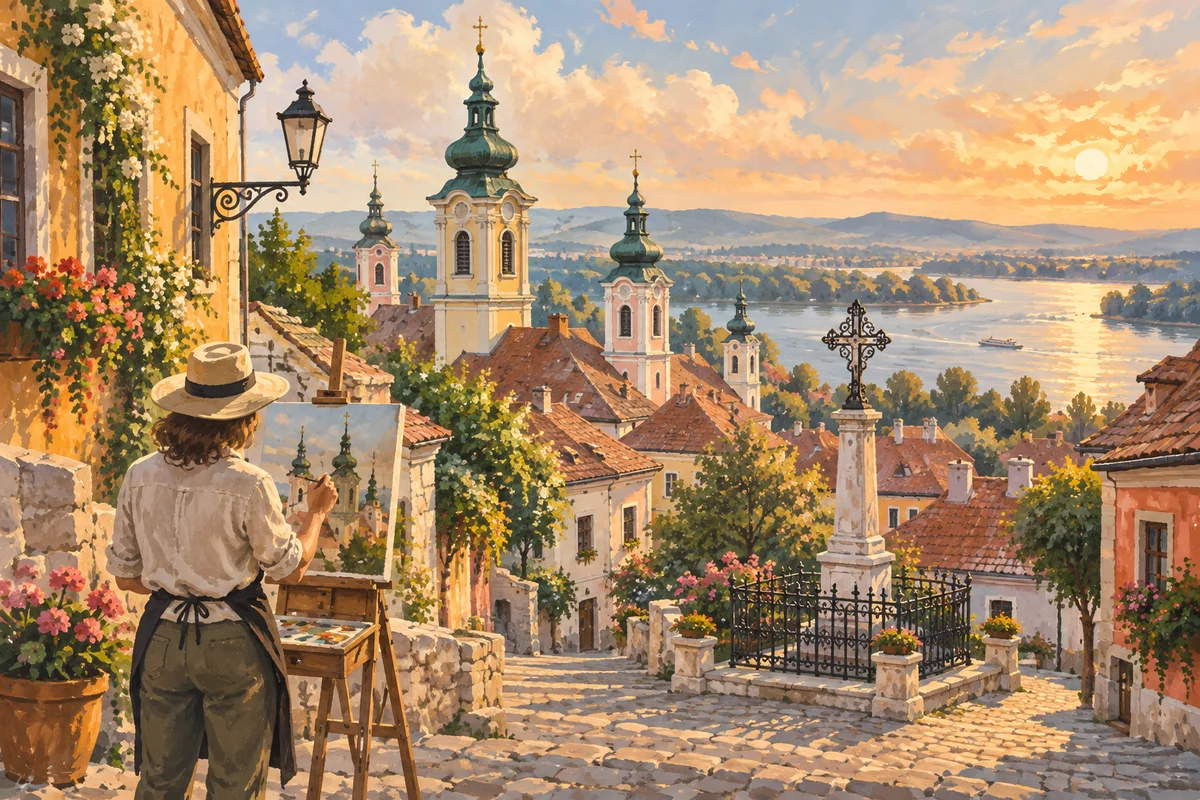
In late autumn 1690, refugees arrived at a small town on the Danube, twenty kilometres upstream from Buda. They were Serbs: fleeing the Ottoman army, several thousand people led by Patriarch Arsenije III Čarnojević left the Balkans for Habsburg protection, in what historians call the Great Migration. They carried more than bundles and icons: monks from Ravanica Monastery brought the relics of Prince Lazar, the hero of the Battle of Kosovo.
The newcomers stayed a long time. Each community — from Belgrade, Požarevac and Chiprovtsi, and the tanners from Bosnia — built its own quarter and church. Merchants grew wealthy on wine and trade, and within a hundred years the little town became Sveti Andrej, as the Serbs called it: a town with Orthodox bell towers rising above its roofs. In the XX century, when most Serbian families had left, artists came into the empty lanes and made Szentendre their studio.
Along the way you will find a cross beneath which, legend says, a man lies upside down; a stone slab bearing letters of a language no one has spoken here for years; a relief made more than forty years before its museum opened; lángos in a stairway lane; an inventor remembered by a single stone plaque; and a bronze artist beside the Danube.
The route is about a kilometre and a half in a straight line, with a climb up Church Hill: allow two to two and a half hours with stops. From Budapest, take the HÉV suburban train (line H5) to its “Szentendre” terminus. From there it is about ten minutes on foot along Kossuth Street, past the Požarevac Church by the Bükkös stream, to the first stop. Answers come from what you can see on site; halfway through, there is an optional break.
- City: Szentendre
- Route: 11 points
- Time: about 2 h 30 min
- Start: Szentendre, Old Town
- Format: self-guided, any day, no booking
What is on the route
The route points in order — what these places are and why they are interesting. Tasks and answers stay inside the quest.
The Church of Saints Peter and Paul — a church that changed hands — Church of Saints Peter and Paul (Péter-Pál templom), Jakov Ignjatović’s bust beside the fence
A small Baroque church with a single bell tower stands a few steps from pedestrian Dumtsa Jenő Street. Settlers from Chiprovtsi built it around 1751 on the site of a wooden church, and for almost two centuries it was called the Chiprovtsi Church.
The Main Square — the merchants’ cross — Main Square (Fő tér), cross behind the wrought-iron fence in the centre
Merchant houses from the XVIII century surround Szentendre’s Main Square. In its centre, behind a late Rococo wrought-iron fence, a cross rises on a three-sided red marble column.
The Annunciation Church — a church on the corner of the square — Annunciation Church (Blagovesztyenszka szerb ortodox templom), southern side entrance at the corner of the Main Square
The Annunciation Church stands right on the corner of the Main Square, in line with the neighbouring houses, with neither fence nor churchyard: unusual for Szentendre’s Serbian churches, which usually hide behind walls. A faded fresco of Saints Constantine and Helena survives above its side entrance.
Opening hours: during Serbian Church Museum opening hours: May–September Tue–Sun 10:00–18:00, October–April Tue–Sun 10:00–16:00, January–February Fri–Sun only · Ticket: combined church and museum ticket — 1400 HUF, concessions (schoolchildren, students, pensioners) — 900 HUF
Margit Kovács Museum — clay that tells stories — Margit Kovács Ceramics Museum (Kovács Margit Kerámiamúzeum), gate at Vastagh György utca 1
The single-storey corner house with its arched stone gateway and wrought-iron window grilles was built around 1759, first as a salt warehouse, then a merchant’s house. Since 1973 it has housed the collection of Margit Kovács, Hungary’s best-known ceramics artist of the XX century.
Opening hours: daily 10:00–18:00 · Ticket: adults 1500 HUF, concessions 750 HUF (according to Szentendre’s tourism website; check at the ticket office)
Lángos on the stairs (optional) — Álomlángos lángos shop (Álomlángos Szentendre), Váralja lépcső stairway lane
The narrow Váralja stairway lane climbs from the Main Square to Church Hill between the walls of old houses. Its name is straightforward: in Hungarian it means “stairs beneath the fortress”.
Opening hours: daily 11:00–18:00, season roughly from 15 March to 15 November
Church Hill — rooftops from above — Church Hill, Church of Saint John the Baptist (Keresztelő Szent János-templom), southwestern corner of the bell tower
Church Hill rises directly above the Main Square. From its stone enclosure you can see tiled roofs, the bell towers of Serbian churches and a strip of the Danube beyond.
Belgrade Cathedral — the Serbian episcopal church behind a wall — Alkotmány Street (Alkotmány utca 7), wall beside Belgrade Cathedral’s enclosure
Szentendre’s largest Serbian church hides behind a high stone wall in a shady garden; only its bell tower can be seen from the street. Everyone calls the Cathedral of the Dormition of the Mother of God the Belgrade Cathedral, because its community was founded by settlers from Belgrade who arrived in 1690.
Opening hours: cathedral open to tourists from 1 March to 30 October, Fri–Sun 10:00–16:00; at other times for services only · Ticket: cathedral admission — 500 HUF
Tsar Lazar Square — seven years with a sacred relic — Tsar Lazar Square (Lázár cár tér), cross on a column by the Danube embankment
Steep stepped lanes descend from Church Hill towards the river. One reaches a little square by the embankment, where a plain iron cross stands on a stone column with a carved capital.
The Transfiguration Church — the tanners’ quarter — Vujicsics Square (Vujicsics Tihamér tér), fountain by the Transfiguration Church, Bogdányi utca 42
The Transfiguration Church stands behind a stone fence at the foot of the hill. Before its gates, a fountain with a tall stone column plays in a small square.
Saint Urban’s Cross — protection from frost — Winegrowers’ Cross, also Saint Urban’s Cross (Szőlősgazdák keresztje), wall niche at the corner of Dézsma utca and Ady Endre út
In a niche in an old stone wall, behind a low railing, stands a stone column without a capital, crowned by an openwork wrought-iron cross with two crossbars. It is considered Szentendre’s oldest roadside cross.
Czóbel Park — an artist on a bench — Bronze statue of Béla Czóbel (Czóbel Béla) in Czóbel Park, corner of Ady Endre út and the Danube embankment
In a small park beside the Danube, on the site of a former studio, a bronze old man in baggy clothes sits on a bench, gazing thoughtfully ahead. He is painter Béla Czóbel.
Where to go next
This route is part of MeTravel city quests. Below are the other quests in this city and cities with quests nearby.
Quests in nearby cities
- Вишеград
— 1 quest, 16 km
- Будапешт
— 1 quest, 19 km
- Банска-Штявница
— 1 quest, 89 km
- Эгер
— 1 quest, 101 km
Travels: Szentendre
Traveller articles about this city will help round out the walk.