
MeTravel city quest
Pécs quest: from Sopianae to Zsolnay
Pecs: a free walking route “Pécs quest: from Sopianae to Zsolnay” past the sights. Self-guided, any day, no booking. 11 points. Approximately 2 h 30 min.
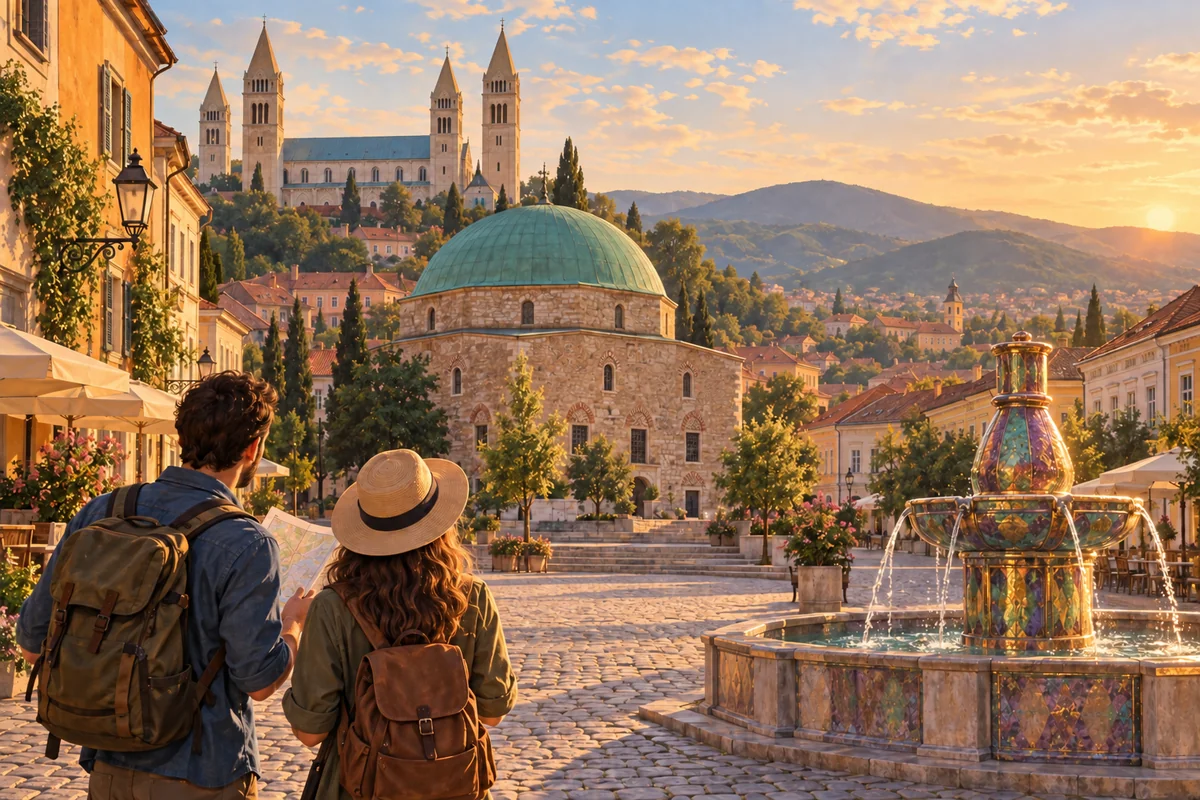
Pécs lies on the southern slopes of the Mecsek hills, and in two thousand years it has had more names than some cities have changed shop signs. The Romans called it Sopianae, medieval scribes Quinque Ecclesiae, “Five Churches”, Germans Fünfkirchen, and Ottomans Peçuy. Each name left its own clue in the city, and all lie within half an hour's walk of one another.
Beneath the cathedral square hide painted burial chambers from the IV century, the reason Pécs entered the UNESCO World Heritage List. On the main square stands a church that was a mosque four hundred years ago and has made no attempt to hide it. On a quiet street, lovers have been fastening their promises with padlocks for over half a century. Across the centre, ceramics from the local Zsolnay factory flash with rainbow colours, the same factory whose patterned roof tiles are familiar from Budapest's rooftops.
Our route will pass through these layers: from the Ottoman outskirts across the bishop's hill to Széchenyi Square and on to the theatre on pedestrian Király Street. Along the way we will meet a bronze historian, a poet-bishop whose real face nobody knows, and a fountain that spent almost twenty years in storage before the city found it a place.
What to do: 1) Read the story and task at each stop. 2) Find the place on the map and approach it. 3) Look around and answer the question.
This is a walking route, about two kilometres in straight-line distances, entirely in the old centre. Two stops, the museum and lunch, are optional. We start on the southern edge of the old town, at the mosque with the slender minaret.
- City: Pecs
- Route: 11 points
- Time: about 2 h 30 min
- Start: Pécs, old town
- Format: self-guided, any day, no booking
What is on the route
The route points in order — what these places are and why they are interesting. Tasks and answers stay inside the quest.
The Mosque of Jakovali Hassan Pasha: the last minaret — Mosque of Jakovali Hassan Pasha, bronze statue by the entrance (Ibrahim Pecsevi)
On the southern edge of old Pécs, behind the fence of a small garden, stands a low square domed mosque, beside a slender polygonal minaret with a circular balcony. It was built in the second half of the XVI century, when Pécs spent a century and a half as the Ottoman town of Peçuy.
Opening hours: usually Tue–Sun 10:00–18:00 (October–March 9:00–17:00), closed Monday; in summer 2026 the website warned of construction work, so check visiting hours in advance · Ticket: 2500 HUF, concessions 1250 HUF (ages 6–26 and over 62)
The Barbican: a round tower and a poet-bishop — Garden by the Barbican, northwest corner of the old walls (Barbakán)
The round stone tower with arrow slits in the northwest corner of the old town is the Barbican, the last surviving outpost of the walls surrounding the bishop's fortress of Pécs. Such projecting fortifications were placed before gates so attackers had to pass along the walls under defenders' fire instead of assaulting the gate head-on.
The Cathedral of Peter and Paul: four towers above the city — Cathedral south entrance, St Stephen’s Square (Pécsi Szent Péter és Szent Pál Székesegyház)
Four identical towers around sixty metres high, one at each corner, make the Cathedral of Saints Peter and Paul recognisable from anywhere in Pécs. Stone apostles line up above the arcade of its south facade, while heavy bronze gates at the south entrance look from afar like a lace curtain.
Opening hours: Mon–Fri 9:00–17:00, Sun 11:30–17:00; visits restricted during services and ceremonies, ticket sales until 16:30 · Ticket: single-site ticket 3600 HUF, concessions (students, teachers, pensioners) 2900 HUF
Cella Septichora: the painted tombs of Sopianae — St Stephen’s Square, entrance to the underground visitor centre (Cella Septichora Látogatóközpont)
Directly beneath the square before the cathedral, under concrete slabs and glass roofs, lies the cemetery of Roman Sopianae. It is barely visible from outside: a low entrance pavilion and transparent hatches in the paving, with burial chambers more than sixteen hundred years old below them.
Opening hours: 1 April–3 November Tue–Sun 10:00–18:00 (ticket office until 17:30), in winter Tue–Sun 10:00–17:00 (ticket office until 16:30); closed Monday · Ticket: “World Heritage” ticket 3900 HUF, concessions (students, teachers, pensioners) 2500 HUF, family (2 adults and 2 children aged 6–18) 10 000 HUF
Csontváry Museum (optional) — Janus Pannonius Street, the museum’s old mansion (Csontváry Múzeum)
A stone's throw from the early Christian tombs, in an old house on Janus Pannonius Street, is a museum devoted to a single painter, Tivadar Kosztka Csontváry. His huge canvases hang in the former ballroom: “The Lonely Cedar”, “Baalbek”, “Mary's Well in Nazareth”, paintings almost nobody bought during his lifetime.
Opening hours: Tue–Sun 10:00–18:00, closed Monday · Ticket: 3000 HUF, concessions 1500 HUF (ages 6–26 with student ID, ages 62–70)
The lovers’ railings — Janus Pannonius Street, wrought-iron railings by the school wall (Lakatfal)
On a quiet street between the cathedral and main square, by the back wall of a secondary school, stand wrought-iron railings long since buried under a heap of padlocks: large and tiny, rusty and shiny, engraved or bearing names written in marker.
The Mosque of Pasha Qasim: a church of two faiths — Széchenyi Square, church beneath the green dome (Gyertyaszentelő Boldogasszony-templom)
The upper end of Széchenyi Square is closed by a square building under an enormous green dome; without it Pécs would be unrecognisable on any postcard. Outside it is a mosque as the Ottomans built it; inside it is an active Catholic church, which residents still habitually call the Djami, simply “mosque”.
Opening hours: Mon–Fri 9:00–17:00, Sat 9:00–19:00 (from October 10:00–17:00), Sun 13:00–17:00; visits restricted during services · Ticket: single-site ticket 3600 HUF, concessions (students, teachers, pensioners) 2900 HUF
A break at Korhely (optional) — Boltív köz passage by Széchenyi Square (Korhely)
In narrow Boltív köz passage, a hundred paces from Széchenyi Square, the Korhely restaurant-pub has summer tables outside. Its Hungarian name means a “reveler” or “carouser”, but the food is quite substantial.
Opening hours: daily 11:30–22:00, Friday and Saturday until 23:00
The Zsolnay Fountain: a son’s gift to his father — Lower end of Széchenyi Square, by the Brothers Hospitallers’ church (Zsolnay-kút)
At the lower end of Széchenyi Square, beside the Brothers Hospitallers' church, stands a four-metre ceramic fountain covered in glaze that shifts from gold to green to purple in sunlight. This is eosin, the most famous invention of Pécs's Zsolnay factory and a calling card of the city.
The synagogue on Kossuth Square — Kossuth Square, synagogue main entrance (Pécsi zsinagóga)
The east side of Kossuth Square is occupied by the synagogue of 1869, the largest in Transdanubia, built in the Romantic style with a three-part facade. Stone tablets of Moses crown the main facade, with a Hebrew inscription from Isaiah in the semicircular tympanum beneath them: “My house shall be called a house of prayer for all peoples”.
Opening hours: 1 May–31 October Sun–Fri 10:00–16:00; closed Saturdays and Jewish holidays, winter visits by prior arrangement
The National Theatre: a finale on Király Street — Theatre Square on Király Street, fountains outside the theatre (Pécsi Nemzeti Színház)
Király Street is Pécs's main pedestrian street. Around its midpoint it opens into Theatre Square, where the elegant National Theatre rises behind two fountains, topped by a dome bearing a winged Genius.
Where to go next
This route is part of MeTravel city quests. Below are the other quests in this city and cities with quests nearby.